
★ In this story 02
How many planets are in our solar system, and what is the one farthest out? The answers may reveal your age, because things changed after Aug. 24, 2006. On that day, the answers became eight – and Neptune is the last. But for more than 75 years, there was a ninth planet – Pluto. That tiny dwarf planet is still out there, though, no matter what the modern scientific community says.
Poor Pluto
This tiny planet is smaller than Mercury and the farthest from its neighbor. As such, it was simply impossible to spot with ancient telescopes.
But its presence was clear. Astronomers could tell something big was affecting the orbits of both Uranus and Neptune. Just as Neptune was originally discovered mathematically before it was ever found by telescope, so, too, was Pluto.
In 1930 – about 15 years too late to be included in English composer Gustav Holst’s The Planets symphony – Clyde Tombaugh discovered what would for almost 75 years be known as the ninth planet. Despite being discovered long after anyone believed the planets might be gods, the new planet was still named Pluto in that tradition, honoring the Roman god of the underworld.
But by late 2006, Pluto had lost its planethood. The International Astronomical Union decided during its General Assembly that year in Prague, Czech Republic, to demote Pluto to a dwarf planet.
This happened because the organization changed the definition of planet so that any object labeled planet has to have cleared its orbit. Pluto is in the Kuiper Belt, a region of debris out past Neptune. It shares this space with thousands of objects, including another dwarf planet close in size called Eris.
A Planet on the Edge
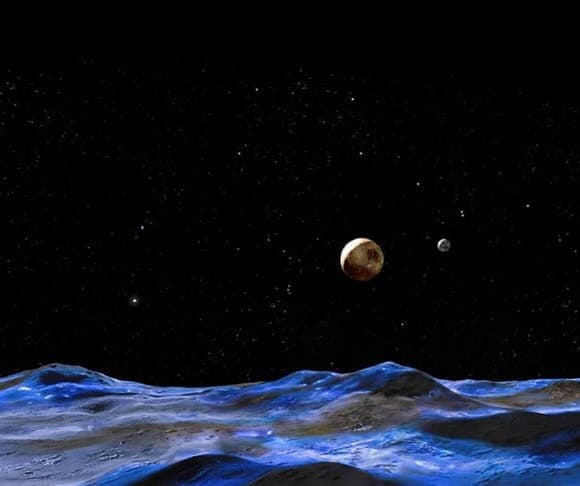
Pluto is about 3.6 billion miles away from the sun – or roughly 40 times farther than Earth is. Its home, the Kuiper Belt, is a huge ring of icy objects out beyond Neptune. Some scientists even believe that Pluto might not have formed the same way the rest of the planets and is, instead, a “captured” object hurtling through space that got trapped by the sun’s gravity.
The dwarf planet is less than half the size of Mercury and just two-thirds the size of Earth’s moon. Pluto’s diameter, 1,473 miles, is slightly shorter than the drive from Boston, MA, to Miami, FL! Pluto is believed to be a rocky core surrounded by a mantle of ice and a surface of frozen nitrogen, methane, and carbon monoxide.
It takes 248 Earth years for Pluto to make one full trip around the sun and almost six-and-a-half Earth days to make a single revolution. Pluto has five moons: Charon, Nix, Styx, Kerberos, and Hydra. The largest, Charon, is about half the size of the dwarf planet, and they’re tidally locked together, meaning Charon hovers around the same spot on Pluto.
This little planetoid also has a more oval orbit than any other major body in the system; at some points, it’s even closer to the sun than Neptune! But don’t worry, even though they do cross paths, their orbits are timed so that they’re never both at that intersection at the same time.
The surface of Pluto has mountains, valleys, plains, and craters, though impacts are very rare. Still, the surface is far from a safe environment, as temperatures can drop to negative 400 degrees Fahrenheit. But we have sent a probe out to Pluto. Launched in 2006, the NASA’s New Horizons made its historic flyby and took high-resolution photos in 2015. The whole trip took about nine-and-a-half years. There aren’t any plans for manned trips to Pluto, but who knows? Perhaps someday the dwarf planet that used to be our number nine may be the last stop on the first deep space mission.
Try a quiz based on this article
Pluto was the ninth planet in our solar system until August ______.
Show the answer
2006.
Pluto was discovered mathematically before it was found using a telescope, just like what other planet?
Show the answer
Neptune.
Pluto was named after the Roman god of:
Show the answer
The underworld.
Pluto was discovered in time to be included in English composer Gustav Holst’s The Planets.
Show the answer
False.
In what year did Clyde Tombaugh discover Pluto?
Show the answer
1930.
What is the name of the region in space located beyond the orbit of Neptune and the home of Pluto?
Show the answer
Kuiper belt.
Pluto lost its planet status after the International Astronomical Union demoted it to dwarf planet.
Show the answer
True.
Which of Pluto’s five moons is the largest?
Show the answer
Charon.
Pluto’s orbit makes a(n) _____ shape.
Show the answer
Oval.
What is the name of NASA’s probe launched in 2015 that took high-resolution photos of the planet?
Show the answer
New Horizons.