
★ In this story 03
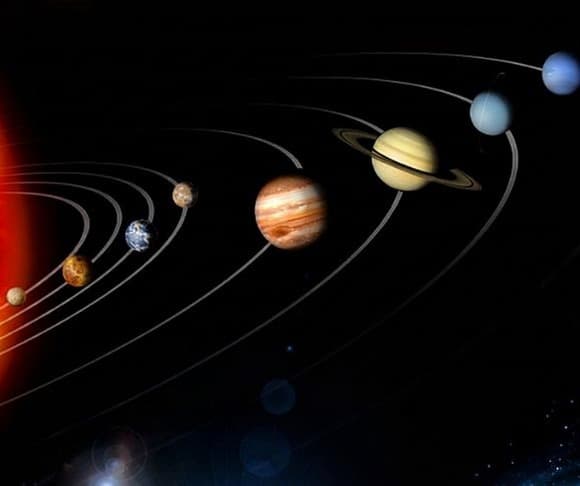
Earth may be the most unusual planet orbiting our sun. After all, what other can boast life –plant, animal, or otherwise? A close runner-up, however, would be the seventh planet out, Uranus. With temperatures as low as negative 357 degrees Fahrenheit, it’s the coldest planet we know. But that’s not all – it also spins on its side!
An Oddball Planet
Scientists believe Uranus formed about 4.5 billion years ago in the early days of our solar system. Somehow, unlike the rest of the planets in our system, Uranus ended up tipped over, spinning on its side rather than around a vertical axis. Of course, no human researcher was around 4.5 billion years ago – nor has anyone ever traveled so great a distance as the roughly 1.7 billion miles to Uranus. In fact, at our present level of technology, it would take an estimated eight and a half years to get there under the best of conditions.
All of that is to say, we don’t know what caused Uranus to tilt on its axis. The leading theory, however, is that something huge – another planet, perhaps – smashed into it and knocked it over.
As mentioned, it’s the coldest planet. The terrible conditions don’t stop there, however. The winds roar around its atmosphere as fast as 560 miles per hour. There’s no solid surface that we have detected. It is a gas giant big enough to swallow up about 63 Earths, and the atmospheric pressure would be crushing. Finally, what passes for air there would be toxic to humans.
And while the planet spins slightly faster than ours, resulting in slightly shorter days, it takes 84 Earth years for it to orbit the sun once. So even if people could visit the planet, they’d live an entire lifetime before seeing their next birthday!
Moons With Potential
Uranus has 28 moons that we have calculated, and scientists have divided them into three groups. The five major moons are Miranda, Ariel, Umbriel, Titania, and Oberon, named after characters from the works of William Shakespeare and Alexander Pope. Miranda has one of the strangest landscapes in the known universe, featuring giant fault canyons, some as much as 12 times as deep as the Grand Canyon. Ariel seems to be the youngest of the moons of Uranus, because it has relatively few large craters. Umbriel, the darkest of the moons, reflects only 16% of the light that strikes its surface. Titania is the largest, though it’s still smaller than our moon. Oberon is the second largest moon and likely one of the oldest, judging by the craters. All five are believed to be roughly half-rock, half-ice. Scientists believe the major moons could have oceans of water beneath their surface, where life might be possible.
There are also 14 inner moons that orbit within or are connected to the planet’s rings. The remaining ten known satellites of Uranus are called the irregular moons; they’re small – ranging in size from just over six miles to 124 miles in diameter. They are called irregular because of their orbits, some of which actually run backward. They’re not formed of the debris disk like the others but are believed to be captured asteroids.
Uranus, the Magician
Uranus is the first planet not known to the ancients. It was first discovered by British astronomer William Herschel in 1781. In continuing the trend of naming planets after Greek and Roman gods, this new discovery was named for the Greek god Ouranos (translated to Uranus in Latin), the ruler of the sky. In mythology, he was the father of Saturn (Cronus) and the grandfather of Jupiter (Zeus).
In his 1916 suite titled The Planets, English composer Gustav Holst gave “Uranus, the Magician” a playful and mysterious sound. The piece is known for its showy brass fanfare and sudden musical changes designed to reflect the “magician’s” tricks.
Try a quiz based on this article
The seventh planet from the sun, Uranus, is:
Show the answer
The coldest planet.
Uranus spins on its side rather than around a vertical axis.
Show the answer
True.
At roughly 1.7 billion miles away, it would take an estimated ______ to travel to Uranus.
Show the answer
8.5 years.
How many moons does Uranus have?
Show the answer
Twenty-eight.
The five major moons — Miranda, Ariel, Umbriel, Titania, and Oberon — are named after characters from the works of Alexander Pope and:
Show the answer
William Shakespeare.
Which major moon on Uranus is believed to be the youngest?
Show the answer
Ariel.
All five of the major moons are believed to be half-ice, half-rock.
Show the answer
True.
Who first discovered Uranus?
Show the answer
William Herschel.
Like the other planets, Uranus was named after:
Show the answer
Greek and Roman gods.
English composer Gustav Holst named the Uranus portion of his musical suite The Planets “Uranus the:
Show the answer
Magician”.