
★ In this story 03
The dodo bird is believed to have become extinct sometime in the 17th century, though some believe the bird never existed at all and is just a mythical creature. Scientists, however, are hoping to bring the dodo bird back from extinction. Experts in the field also hope to rejuvenate the Woolly Mammoth and Tasmanian Tiger (thylacine) populations. How is this possible? And what is the probability scientists can accomplish this?
The Dodo Bird
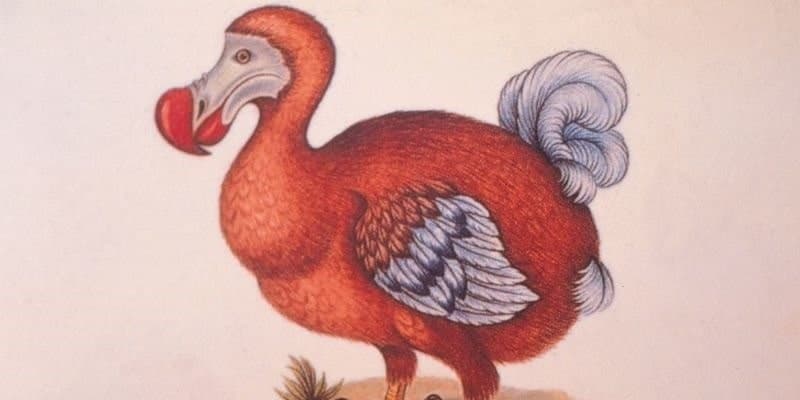
The dodo is a flightless bird that lived in the wooded areas of Mauritius Island off the coast of Madagascar. Thought to have gone extinct sometime in the 1600s, there is little known about the creature’s appearance and behavior.
Subfossils located near the island are the only tangible remnants of the mysterious bird. Based on them, the dodo is believed to have been about 3ft 3 in tall and likely weighed between 23-39 lbs. Drawings and writings from earlier times depict the animal as brown and grey with yellow feet and a green, yellow, and black beak. Scientists believe they were flightless due to the abundance of food in the area and the minimal number of predators on the island.
The first mentioned spotting of the dodo was by sailors in 1598. Interestingly, the last presumed sighting of the animal was in 1662. That time frame suggests that the bird existed for a very short time. Unfortunately, humans are largely to blame for their extinction, as it is believed that these animals were highly sought out by hunters and invasive species such as rats, pigs, and monkeys brought to the island on boats.
The Science Behind the Plan
Bringing extinct species of animals back to life, is this even possible? Well, a team of researchers from Colossal Biosciences seems to think so.
“The Colossal Biosciences researchers will begin by removing germ cells from the eggs of the Nicobar pigeon, the dodo’s closest living relative,” Emily Jones from DOGO News explained. “The genes will be edited to make them more dodo-like and implanted back into the eggs. The scientists will then incubate the eggs. If successful, the eggs will hatch and we will have our first dodo-like bird.”
The Potential Downside
This type of breeding has seen success in chickens. The difference is recreating an animal that has not existed for a few hundred years. Some have questioned whether the dodo-like bird could live and thrive in the wild. Others wonder if the lab-created animal will behave like a dodo. Additionally, there are concerns that putting time and money into re-inventing a species is a waste.
Julian Hume, a paleontologist at the Natural History Museum in London, stated: “There’s so many things that desperately need our help. And money. Why would you even bother trying to save something long gone, when there’s so many things that are desperate right now?”
Maybe scientists are putting the cart before the horse on this one. Is it more essential to renew a species that has been gone for centuries or save the ones living on Earth right now?
Jeremy Austin, an evolutionary biologist, told Australia’s Sydney Morning Herald: “De-extinction is a fairytale science. It’s pretty clear to people like me that thylacine or mammoth de-extinction is more about media attention for the scientists and less about doing serious science.”
What do you think?
Test Your Knowledge – Take the Quiz
Try a quiz based on this article
Along with the Dodo, scientists hope to revive the Tasmanian Tiger and _________.
Show the answer
The Woolly Mammoth.
Dodo birds became extinct sometime in the ______.
Show the answer
1600s.
Dodo’s are believed to have weighed between 23 and 39 pounds.
Show the answer
True.
Pictures and drawings of the bird depict the animals feathers to be ________.
Show the answer
Brown and gray.
The primary reason for the dodo’s extinction is?
Show the answer
Hunting.
Animals that hunted dodo’s were brought to the island on boats.
Show the answer
True.
Scientists are using germ cells from the eggs of the dodo’s closest relative, the _______.
Show the answer
Nicobar pigeon.
What animal have scientists successfully bred this way?
Show the answer
Chickens.
Some question the importance of rejuvenating a centuries-gone species.
Show the answer
True.
What did evolutionary biologist Jeremy Austin call de-extinction?
Show the answer
A fairy-tale science.

Kirsten Brooker
Culture Correspondent for Liberty Nation and Generation Liberty. Kirsten loves to write about culture from the point of view of an everyday American who lives deep in the heart of the Midwest. She is the mother of two adorable girls, likes classic rock, and humbly wears the crown of a former Homecoming Queen with grace and style.