


Tibet, located in East Asia, is nicknamed the “Roof of the World” due to its towering mountain peaks. Currently under Chinese rule, Tibetans are fearful for the future of their people and how they live. Tibetan leader Sikyong Penpa Tsering was recently invited to visit Washington, DC, to speak with US officials. He was hoping to gain help from the US to preserve the Tibetan culture.
The Autonomous Region of Tibet
Tibet, nestled in the Himalayan mountains, has been ruled over the centuries by different groups. Sometimes it was ruled by local dynasties, while at other times the Chinese royal families took charge.
From 1912, it became an independent nation. However, changes came in 1949 with the creation of the People’s Republic of China. In 1950, thousands of Chinese troops were sent to Tibet to claim the region as their own. This resulted in parts of Tibet being merged into other Chinese provinces, and some areas becoming the Tibetan Autonomous Region. The area is “autonomous,” which means it has some authority to rule itself, but the Chinese government has the final say.
The Chinese invasion led to the banishment of hundreds of thousands of Tibetan residents. Their Buddhist spiritual and political leader, the Dalai Lama, was exiled to India. A portion of the region’s monasteries were destroyed in the 1960s and 70s, and thousands of Tibetans were believed to have been killed during China’s Cultural Revolution.
Today, there are concerns that China is trying to quash the unique Tibetan culture and language. Freedom is restricted, and people who oppose the Chinese rule are treated as criminals.
What are Penpa’s Hopes?
A lot of Tibetans settled in the Indian city of Dharamshala, after fleeing their homeland. They set up a government-in-exile to represent them and promote their cause around the world. Sikyong Penpa Tsering is a politician working in this government.
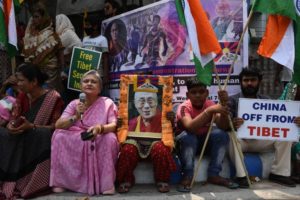
On his recent visit to Washington, DC, Penpa asked for support from the US government. He wants the United States to help convince China to communicate with his Dharamshala government.
He compared Tibet’s situation to the troubles experienced by China’s Uighur Muslims, adding that, “The policies adopted by [Chinese President] Xi Jinping today are aimed completely at the eradication of the Tibetan and other minority nationalities’ identities.”
The United States’ Position
This visit has been seen as a strong sign of support for Tibet by President Joe Biden and his officials. Biden recently signed a law which dedicated $21 million to sustain the Tibetan culture. Tibet has also gained support from several American officials, such as US Secretary of State Antony Blinken, plus Representatives Chris Smith of New Jersey and Scott Perry of Pennsylvania.
American diplomat Uzra Zeya was given the job of a special coordinator for Tibetan issues. She stated: “We believe a negotiated agreement that leads to meaningful autonomy for Tibetans and ensures they can preserve their distinct religion, culture, and language provides the best hope for long-term stability in the region.”
Is that a realistic goal? Without cooperation from the Chinese government, there is little anyone can do to help prolong the Tibetan way of life. So far, China has not supported Zeya’s job. Chinese spokesperson Liu Pengyu said it “interferes in China’s internal affairs. We firmly oppose it and never recognize it.”
Despite China’s opposition, Zeya plans to travel to India to meet with the Dalai Lama. It seems the United States plans to do more to help the Tibetans, or at least the population in Dharamshala.
Try a quiz based on this article
Tibet is located in ______ Asia.
Show the answer
East.
Tibetan leader, Sikyong Penpa Tsering, was recently invited to visit Washington DC.
Show the answer
True.
Tibet is nicknamed ‘The Roof of the World’ as it is nestled in the _________ mountains.
Show the answer
Himalayan.
The creation of the People’s Republic of China in _____, brought major changes to the once independent nation of Tibet.
Show the answer
1949.
Which answer best defines ‘autonomous’?
Show the answer
Governed by another nation.
What is the name of the Buddhist spiritual and political leader of Tibet?
Show the answer
Dalai Lama.
The Chinese invasion led to the banishment of the Dalai Lama to _______.
Show the answer
India.
The purpose of Penpa’s visit to America is to gain support in preserving his nations culture.
Show the answer
True.
What happens to those who oppose the Chinese rule?
Show the answer
They are treated as criminals.
President Biden recently dedicated _____ million dollars to support Tibetans and their culture.
Show the answer
21.

Kirsten Brooker
Culture Correspondent for Liberty Nation and Generation Liberty. Kirsten loves to write about culture from the point of view of an everyday American who lives deep in the heart of the Midwest. She is the mother of two adorable girls, likes classic rock, and humbly wears the crown of a former Homecoming Queen with grace and style.