
★ In this story 02
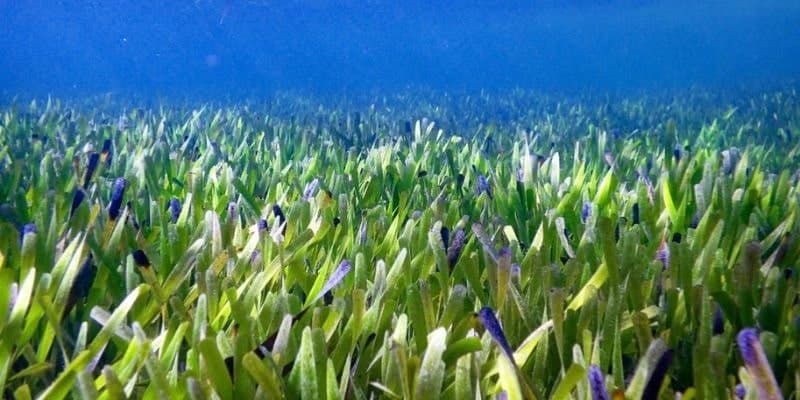
A meadow under the sea? A newly discovered plant found in Australia can be described just like that. The Posidonia australis is a marine flowering seagrass that stretches for miles under the shallow western Australian waters. It is so massive that it has been classified as the world’s largest living plant. Though not a record-breaking age, the underwater field is believed to be around 4,500 years old. Let’s discover what exciting things scientists have uncovered about the giant foliage.
How Big Is It?
The underwater phenomenon covers more than 112 miles of the protected wilderness known as Shark Bay. The seagrass can grow large because it creates identical copies of itself (clones) extending from the original growths. This process is abnormal for reproduction in the wilderness and is mainly associated with fungi, bacteria, and some plants. Specific environmental conditions are needed for this type of re-creation to occur.
It would seem that each blade of seagrass would be its own plant. However, in the case of the Posidonia australis, the sequence of DNA evaluated by scientists revealed that it is one solitary plant, making it the most prominent living vegetation in the entire world. Elizabeth Sinclair is a senior researcher at the School of Biological Sciences and Oceans at the University of Western Australia. Along with other scientists, she removed samples of the grass in 2012 and 2019. After running several tests and considering the environment and other living conditions, they learned how these interesting plants grow and reproduce at such magnitude.
“The plant has been able to continue growing through vegetative growth – extending its rhizomes (rootstalks) outwards – the way a buffalo grass would in your back garden, extending runners outwards. The only difference is that the seagrass rhizomes are under a sandy seafloor so you don’t see them, just the shoots within the water column,” Sinclair said.
Another fascinating fact about the meadow is that it has twice the number of chromosomes of the other seagrasses that have been studied. Typical plants have 20 chromosomes; Posidonia australis contains 40. Examiners believe that the enhanced number of chromosomes has allowed the plant to survive in many conditions like saltier waters, various levels of light, and fluctuating temperatures. If left alone, the vegetation could grow continuously.
Sinclair said, “Individual seagrass clones may persist almost indefinitely if left undisturbed, as they rely on vegetative, horizontal rhizome expansion, rather than sexual reproduction.”
Posidonia Australis – A Home for Sea Life
Environmental agencies protect the plant and animal life within Shark Bay. The grassy, underwater fields sustain the lives of many fish and other aquatic plants and animals. Seagrass meadows are one of the most productive ecosystems on the planet. They supply food and shelter for sea horses, swimmer crabs, and hundreds of fish. In addition, the thick foliage acts as a shield for many creatures hiding from predators in the waters.
The seagrass also gets credit for slowing down climate change due to its ability to store carbon at a much higher rate (about 40%) than forests and land plants.
Additionally, the giant plant helps the land by slowing erosion at the shoreline and reducing the effects of sediment – the stuff that settles on the ocean floor. The giant meadow also contributes to water clarity, as it naturally dissolves nutrients and sediment in the water.
The benefits of the world’s largest plant are seemingly endless. We must protect the precious waters and the plant and animal life that depend on them for survival.
Test your knowledge – try a quiz based on this article!
Try a quiz based on this article
On what continent does the largest living plant exist?
Show the answer
Australia.
Approximately how old is the Posidonia australis?
Show the answer
4,500 years old.
The underwater meadow is ______ miles long.
Show the answer
112.
The plant ______ itself, allowing it to grow larger and larger.
Show the answer
Clones.
Posidonia australis is one single plant.
Show the answer
True.
The seagrass has ______ the number of chromosomes of other seagrasses.
Show the answer
Twice.
The explanation for the high number of chromosomes is the plant’s ability to survive constantly changing ______________.
Show the answer
Living conditions.
What is an ecosystem?
Show the answer
A system of living things within an environment.
The giant plant acts as a protector against _____ in the water.
Show the answer
Predators.
The plant also helps the land by slowing erosion at the shoreline.
Show the answer
True.

Kirsten Brooker
Culture Correspondent for Liberty Nation and Generation Liberty. Kirsten loves to write about culture from the point of view of an everyday American who lives deep in the heart of the Midwest. She is the mother of two adorable girls, likes classic rock, and humbly wears the crown of a former Homecoming Queen with grace and style.