
★ In this story 02
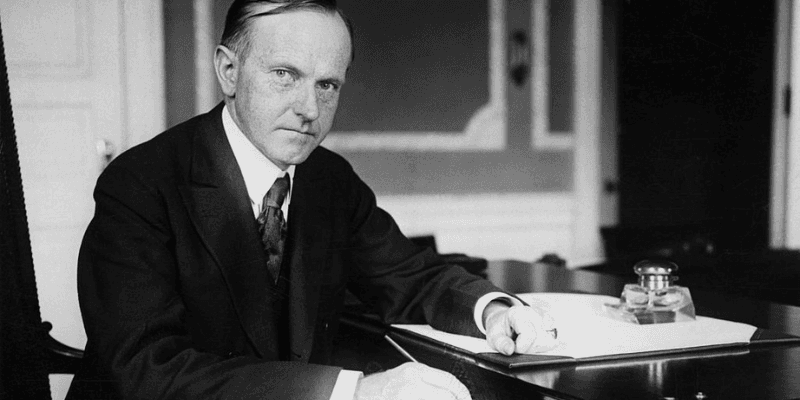
Calvin Coolidge (1872 – 1933) became the 30th president of the United States after President Warren G. Harding died suddenly. He had been visiting home in Vermont when he learned of Harding’s death. Coolidge’s father was a notary public, and so since it was the middle of the night when Coolidge got the news, his own father swore him into office. Coolidge’s term took Americans through the roaring ‘20s and ended a year before the Great Depression.
The Early Years
Coolidge was born John Calvin Coolidge Jr. on July 4, 1872, in Vermont. His father ran the post office and a general store. His mother died when he was just 12 years old.
Coolidge attended Amherst College in Massachusetts, graduating in 1895. He went on to study law and became an attorney in Northampton, where he met Grace Anna Goodhue, a teacher at a school for deaf children. They married in 1905 and had two sons, John and Calvin Jr.
Coolidge’s political career started in 1898 when he was elected to the Northampton, Massachusetts city council. He served in a number of other political positions in the state, including as governor. He gained recognition and caught the attention of national politicians while he served as governor when the Boston police force went on strike and riots broke out.
After restoring order, Coolidge refused to allow the striking officers to go back to work, saying in a telegram to the labor leader that “there is no right to strike against the public safety by anybody, anywhere, anytime.” In 1920, the Republican National Convention chose him to run as vice president on Harding’s ticket.
President Coolidge
Coolidge became president on August 3, 1923. The new president immediately went to work on damage control from the previous administration’s scandals. He fired Harding’s attorney general and investigated the Teapot Dome oil-lease issue, which sent the secretary of the interior to prison. His quick actions restored faith in government to the American people and soon he earned the nickname “Silent Cal” for his no-nonsense approach and polite manner. When he ran for re-election in 1924, he won easily.
Despite his reputation for being quiet, Coolidge understood the power of publicity. He held regular press conferences and used radio broadcasts to reach Americans. His first address to Congress in December 1923 became the first presidential speech to Congress broadcast over the radio.

The year 1924 also brought personal tragedy. Coolidge's 16-year-old son, Calvin Jr., developed a blister while playing tennis at the White House. The blister became infected, and he died of blood poisoning on July 7. The president was devastated by the loss.
The Roaring Twenties was a time where women were starting to be more progressive after getting the right to vote in 1920 and citizens were enjoying life and spending money. The economy seemed to be doing really well and the president was seen as a father figure, someone who had guided the people out of trouble and into a successful new era.
Coolidge believed in limited government, lower taxes, and reduced federal spending. He signed major tax cuts in 1924 and 1926, arguing that businesses and individuals should keep more of their earnings. However, the prosperity wasn't shared equally. Many farmers struggled financially, and critics argued that his hands-off approach allowed risky stock market speculation to grow.
In 1924, Coolidge signed the Indian Citizenship Act, granting U.S. citizenship to all Native Americans born in the country. However, citizenship did not guarantee voting rights, and many Native Americans continued to face state laws that prevented them from voting.
When election time came around again in 1928 Coolidge didn’t run for re-election. He returned to Northampton and busied himself writing his memoirs and contributing pieces to magazines. In less than a year after he left the Oval Office, the stock market crashed, and America entered the Great Depression. He admitted to friends that he was partially to blame and that he’d spent his presidency “avoiding the big problems.” Less than five years after retiring, Coolidge died of a heart attack on January 5, 1933, at the age of 60.