
★ In this story 03
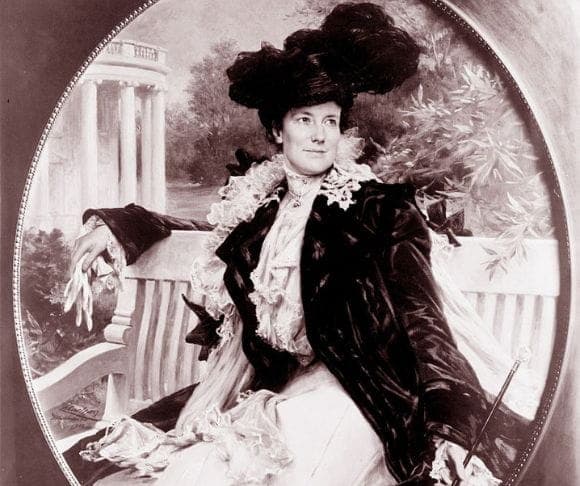
To be the first lady for President Theodore (Teddy) Roosevelt, one had better be relatively bullish and not a shrinking violet. Edith Roosevelt was just that kind of lady: intellectual, energetic, and a good friend to her husband. Her ability to balance tradition with a rapidly changing new world helped establish expectations for future first ladies.
Edith was rumored to have an innate radar for people: She could decide relatively fast whether people had a good moral compass and others who had ulterior motives. A lot of people in DC, even back in the early 1900s, had motives that weren’t worn on the sleeve. Her husband claimed: “Whenever I go against her judgement, I regret it.” But her greatest strength in the role of first lady was knowing her husband inside and out since they were children. The two had unbreakable loyalty and friendship. And Edith loved the job.
The Young Edith Roosevelt
Teddy and Edith grew up in Manhattan, NY, in the pricey streets of New York's Union Square neighborhood. Both families moved in the same social circles. Edith Kermit Carow was a close friend of Teddy’s sister, Corrine, and considered her future husband as this intense boy with a shock of auburn hair and a habit of passionate debate.
It was matriarch Mittie Roosevelt who decided that Edith would be tutored alongside her children. Young Edith became a fixture of the Roosevelt family, often included on family vacations in Oyster Bay.
Both families thought the close friendship would lead to marriage, but Theodore fell for a beautiful woman named Alice Hathaway Lee. They were married, but Alice died just after giving birth to their daughter (also named Alice), who the grief-stricken man doted on. No one would believe that Teddy would ever marry again.
Edith and Theodore renewed their friendship and – very quietly, without fanfare, and with respect for Alice – they married in London in 1886.
Mrs. Teddy
Edith mostly took care of the domestics like her peers of the time: She kept the kids cleaned, fed, educated, and presented to society. The future first lady raised Alice, Theodore Jr., Kermit, Ethel, Archibald, and Quentin. The Roosevelt children were famous for outside adventures, weird pets, and a lot of mischief.
They took up residence in a 22-room Queen Anne-style house in Oyster Bay, originally designed for Theodore's first wife, Alice. Edith was constantly reminded of the beautiful first wife and was compared mercilessly by outsiders. Alice was ethereal, socially in demand, unequaled in style and beauty. Edith was a mother, an intellectual, practical, and unpretentious.
When Theodore became president in 1901 following the assassination of William McKinley, Edith entered the White House determined to make changes. They were necessary with a houseful of rambunctious children, so Edith separated the office and the personal residence. The children were encouraged to be active and loud. Edith once explained: “One cannot bring up boys to be eagles and then expect them to be sparrows.”
First Lady Edith launched a major renovation in 1902 that created a new executive office building that eventually evolved into the West Wing. Her influence was not always obvious. Edith preferred working behind the scenes, offering Theodore advice and helping create stability during his demanding presidency. Under the Roosevelts, the building on 1600 Pennsylvania Ave. became officially known as the White House, rather than simply the Executive Mansion.
Because of Edith Roosevelt, the collection and display of portraits of former first ladies was reimagined. She also supported efforts to protect historic White House furnishings.
When It’s Time to Go
Unlike some public figures, Edith did not seek attention. She valued privacy and carefully controlled access to her family. She was famous to say: “A woman’s name should appear in print but twice—when she is married and when she is buried.” After Theodore's presidency ended in 1909, Edith traveled, fed her appetite by reading more books, and supporting her family.
Edith Roosevelt died on Sep. 30, 1948, at the age of 87.
Her legacy reminds us that leadership does not always require standing in the spotlight. Through careful planning, historical preservation, and organizational skill, Edith Roosevelt helped transform the presidency's most famous residence and redefine the role of America's first lady.
President Theodore Roosevelt may have lost his wife Alice, but it was Edith that could rise to the occasion of being Mrs. Bull Moose. She had grit, determination, and was exactly what her husband needed to ascend to the Executive Mansion. Edith may have lived in the shadow of the ghost of Alice but never once balked at what was coming next with her barn-burning husband.
4 Questions
The story, in brief
Who was Edith Roosevelt before she married Theodore Roosevelt?
Edith Kermit Carow grew up in Manhattan in New York's Union Square neighborhood and moved in the same social circles as the Roosevelts. She was a close friend of Theodore Roosevelt's sister, Corrine, and was tutored alongside the Roosevelt children. She became a regular presence in the family and often joined them on vacations in Oyster Bay.
Why did Edith Roosevelt face comparisons to Alice Hathaway Lee?
Edith lived in a 22-room Oyster Bay house that had originally been designed for Theodore Roosevelt's first wife, Alice Hathaway Lee. Outsiders compared Edith mercilessly to Alice, who was seen as ethereal, stylish, and beautiful. Edith, by contrast, was described as practical, intellectual, unpretentious, and focused on motherhood.
How did Edith Roosevelt change the White House as first lady?
When Theodore Roosevelt became president in 1901, Edith entered the White House determined to make practical changes for a large, active family. In 1902 she launched a major renovation that separated the office from the family residence and created a new executive office building that later evolved into the West Wing. She also helped make White House history and furnishings a greater priority.
What did Edith Roosevelt do after Theodore Roosevelt left office?
After Theodore Roosevelt's presidency ended in 1909, Edith focused on a quieter life. She traveled, read more books, and supported her family. She died on September 30, 1948, at age 87, leaving a legacy of behind the scenes leadership, historical preservation, and organizational skill.