
★ In this story 04
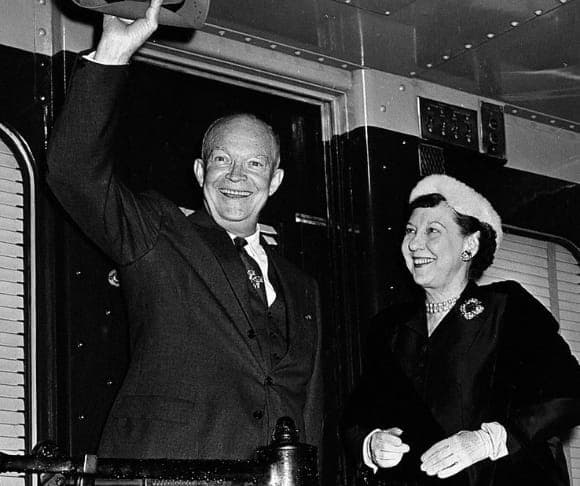
Mary Geneva "Mamie" Eisenhower was the first lady of the United States from 1953 to 1961. She is credited for being a disciplined first lady and also the one who brought fun and festivities back to the White House after the years of solemn duty to country during World War II. As nearly all first spouses can attest, she faced political whisper campaigns with DC’s elite, a hesitant press, and her own personal tragedies under the spotlight on the national stage.
Before Mamie married Dwight D. Eisenhower, known as “Ike,” she enjoyed the life of a wealthy debutante: a classic education in the Denver Public school system followed by the Wolcott School for Girls that taught young ladies to be ready for marriage by being able to play the piano, plan and host dinner parties, and speak French. But it was her father who taught her practical lessons in budgeting and managing personal finance – a skill that proved invaluable when she had to manage a military household on a tight Army budget.
Mamie – A Diminutive Nickname for a Soldier’s Wife
Mary Geneva Doud was born on November 14, 1896, in Boone, Iowa. Midwestern roots with a wealthy upbringing had “Mamie” traveling for vacation spots, including chasing the sun and warmth in the winter. One year saw the Doud family in Houston, TX, for the winter months. A friend invited the family to Fort Sam Houston, where she met Second Lieutenant Dwight Eisenhower – a fresh graduate of West Point. That was 1915, and on February 14, 1916, the couple announced their engagement. They were married on July 1, 1916.
An army wife does not live a glamorous life – and Mamie quickly learned and adapted to a nomadic existence. But a bubbly personality had the young bride charming other wives. The Eisenhower’s moved to 33 different homes during Dwight’s career before they moved into the White House.
But dealing with packing up households and moving across different posts was a walk in the park compared to being the first lady.
Mamie and Her War Hero President
Although Mamie Eisenhower had already learned the demands of military life as a wartime wife, serving as first lady brought a different and often more complicated kind of pressure. As an Army wife, she managed frequent moves, tight budgets, and long separations while creating a stable home for her family. In the White House, however, her every gesture, choice, and relationship could become a subject of public scrutiny. She faced political gossip, an uncertain press, and the challenge of supporting a celebrated war hero whose reputation made the Eisenhowers a target for criticism. The role required more than grace and hospitality; it demanded resilience, discretion, and the ability to maintain warmth and composure on a national stage.
In addition to a more public life, Mamie suffered from Ménière's disease, a chronic inner ear condition that caused her to have balance issues – but critics quick to find fault whispered that she was a heavy drinker. Mamie was not a drinker, but opponents spread rumors through word-of-mouth networks, social clubs, and partisan gossip columnists. This was a strategy in the 1950s used by political enemies hoping to inflict damage without public backlash.
Contrary to a few social circles, Mamie was never a liability or a burden. In fact, Mamie brought joy back to a White House that had remained near shuttered and solemn from World Ward II.
Easter, a Historical Precedent, and a Boo Fest
The First Lady loved pink, pastel colors, and the short bangs that became part of her signature style. In 1953, she and President Eisenhower revived the White House Easter Egg Roll, a cheerful tradition that had been suspended since 1942. Bringing the event back gave the Eisenhowers a chance to add warmth, playfulness, and family-friendly fun to the White House while welcoming children and visitors to the South Lawn. It was exactly the kind of festive occasion that reflected Mamie’s upbeat personality and her desire to make the presidential residence feel lively and inviting.
Mamie was also the first first lady to celebrate and decorate for Halloween. She filled the normally formal and very stuffy State Dining Room with yellow jack-o'-lanterns, corn stalks, red apples, pumpkins, and autumn leaves. Skeletons were hung directly from the wall lights, and the dining tables featured miniature witches riding broomsticks. In the Grand Foyer, she took it up a notch, adding black cats, owls, goblins, and disembodied witch heads hung from the elegant chandeliers.
But a lasting gift Mamie left America was establishing the historical precedent by actively shifting the mansion away from midline department store knock offs to museum-quality American antiques in rooms such as the Diplomatic Reception Room, Vermeil Collection, and successfully creating a Presidential White House China collection. She worked tirelessly in locating and acquiring missing original tableware from the administrations of Andrew Johnson, William Howard Taft, Warren G. Harding, Calvin Coolidge, and Herbert Hoover.
A Bygone Era
The Eisenhowers left political life and retired to their farm in Gettysburg, PA, in 1961, where the former president prized Black Angus cattle, painted, and wrote his memoirs from an office at nearby Gettysburg College. Mamie had nine years with her family complete until Dwight passed in 1969. She stayed on their farm until her passing in 1979.
Mamie Eisenhower, like most wives of an American president was a complexity of equal parts culture, smarts, and common sense.
4 Questions
The story, in brief
Who was Mamie Eisenhower before she became first lady?
Before marrying Dwight D. Eisenhower, Mamie Eisenhower lived as a wealthy debutante. She studied in the Denver Public school system and at the Wolcott School for Girls, and her father taught her budgeting and personal finance, skills that later helped her manage a military household on a tight Army budget.
How did Mamie Eisenhower face criticism in the White House?
Mamie Eisenhower dealt with political gossip, an uncertain press, and personal health challenges while serving as first lady. She suffered from Ménière's disease, which caused balance issues, and critics falsely whispered that she was a heavy drinker, but she was not a drinker and remained a warm, composed public presence.
What traditions did Mamie Eisenhower bring back or start at the White House?
In 1953, Mamie Eisenhower and President Eisenhower revived the White House Easter Egg Roll, which had been suspended since 1942. She also became the first first lady to celebrate and decorate for Halloween, filling formal White House rooms with festive seasonal displays that reflected her playful style.
What did Mamie Eisenhower do after leaving the White House?
The Eisenhowers retired from political life to their farm in Gettysburg, Pennsylvania, in 1961. Mamie Eisenhower had nine more years with her family until Dwight Eisenhower died in 1969, and she remained on their farm until her own death in 1979.