
★ In this story 02
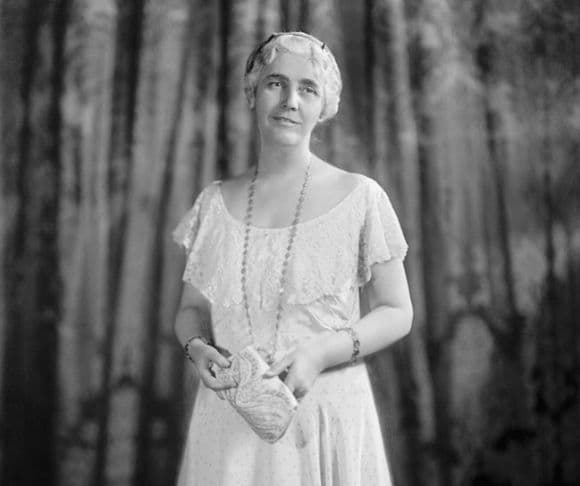
Scholar, philanthropist, and first lady Lou Henry Hoover was not the kind of person who waited around for someone else to make history. She was born in Iowa on March 29, 1874, to parents Charles and Florence Weed Henry, but the family moved around a lot in her youth. Eventually, they headed farther west and settled in the wilds of California, where she eventually met her future husband: Herbet Hoover.
There is a pattern with most US first ladies: They did not wait on a man to begin fulfilling life dreams of education, equality, travel, and philanthropy. Lou Henry fit that blueprint to a T. Lou had a Midwest Nice charm about her with a spark of intensity, and her quirky interests included bicycles, geology, foreign languages, and presidential history. She also had a stubborn streak, and when she felt it was necessary, she was immovable. She was once quoted: “The independent girl is truly of quite modern origin and usually is a most bewitching little piece of humanity.”
Destiny Led West
Educationally ambitious, Lou and her future husband, Herbert Hoover, met while pursuing degrees at Stanford University – both in geology. She became the first woman to earn a geology degree from Stanford, which was a remarkable achievement at a time when women had fewer opportunities to attend college or enter scientific careers.
After graduating, Lou married Herbert Hoover, who worked as a mining engineer. His career took the couple around the world, including to China. Both became fluent in Mandarin, which came in handy a little bit later in their lives. But it was during their stay in China that they found themselves smack dab in the middle of the Boxer Rebellion. During one particular skirmish with heavy shelling, Herbert tried to get Lou to leave, but she refused. It was the Battle of Tientsin, and she worked as a nurse and helped provide milk and supplies while intense fighting raged around them.
Lou’s courage during the Battle of Tientsin set the bar. She rode a bicycle through active gunfire. She carried a pistol that she knew how to use and kept helping people even after a tire was shot out on her ride. Her bravery was well noted and retold by the press: She refused to leave her friends and neighbors and cycled close to walls to avoid bullets. At one point, a newspaper back in California mistakenly published her obituary – which she shrugged off. The Ladies Home Journal once reported she kept playing a game of Solitaire despite a “fog of disintegrated plaster” as the Hoover home splintered under fire.
Lou was also a talented linguist, speaking several languages including Latin and Mandarin Chinese. She and Herbert sometimes used Mandarin to speak privately around White House staff.
A New First Lady: Lou Henry Hoover
The Hoovers came into office with an economy on the brink in early 1929. By October, Wall Street crashed and the first family was faced with the beginning of the Great Depression. Although her husband was attempting to manage a country in chaos, as first lady, Lou continued trying new things intending to give people hope. She became the first presidential wife to deliver a national radio broadcast. And like most first ladies, she helped catalog the historical furnishings of the White House.
Lou made history in another important way when she invited Jessie DePriest, the African American wife of Congressman Oscar DePriest, to tea at the White House. The American South had been through the Civil War not that long ago, and feelings and feathers were ruffled, but it also demonstrated Lou’s willingness to challenge social expectations.
Another Lou Henry creation was Camp Rapidan, a retreat for presidents to decompress from the job. You may know the camp by its modern name: Camp David. She also captured some of the earliest known color motion pictures of the White House. She did what she could to make the residence and her country a little bit better under desperate circumstances and never flinched.
Lou Henry was raised as a strong girl and became an unbeatable woman. Her dad took her camping, hunting, and fishing in her young days, and she knew how to take care of herself. She loved it. And a big part of her life inside the Executive Mansion and beyond was her role in the fledgling organization, Girl Scouts. She was a dedicated leader of the organization and was said to have created behind the scenes the iconic fundraiser, the Girl Scout Cookie sales.
The story of Lou Henry Hoover is a reminder that leadership can take many forms. It can look like studying science, riding into danger, helping strangers, preserving history, or welcoming someone others think should be excluded. She proved that being a first lady was only one part of a much bigger life.
Unexpectedly, Lou suffered a heart attack in January 1944 and passed away, leaving a nation much better off but perhaps not quite yet really understanding her full contribution.
In a 1914 letter, she wrote:
“The ambition to do, to accomplish, irrespective of its measure in money or fame, is what should be inculcated. The desire to make the things that are, better- in a little way with what is at hand [or] in a big way if the opportunity comes.”
Lou Henry Hoover did both.
4 Questions
The story, in brief
Who was Lou Henry Hoover before she became first lady?
Lou Henry Hoover was a scholar and philanthropist who studied geology at Stanford University. She became the first woman to earn a geology degree from Stanford, and she was known for interests including bicycles, foreign languages, and presidential history.
What did Lou Henry Hoover do during the Boxer Rebellion in China?
During the Battle of Tientsin, Lou Henry Hoover worked as a nurse and helped provide milk and supplies while heavy fighting continued around her. She rode a bicycle through gunfire, carried a pistol she knew how to use, and refused to leave her friends and neighbors.
Why is Lou Henry Hoover considered a groundbreaking first lady?
Lou Henry Hoover became the first presidential wife to deliver a national radio broadcast and helped catalog the White House's historical furnishings. She also invited Jessie DePriest, the wife of Congressman Oscar DePriest, to tea at the White House, challenging social expectations in a tense period.
What lasting legacy did Lou Henry Hoover leave after the White House?
Lou Henry Hoover played a major role in the early Girl Scouts and was said to have created behind the scenes the iconic Girl Scout Cookie sales fundraiser. She also helped create Camp Rapidan, the presidential retreat now known as Camp David, and filmed some of the earliest known color motion pictures of the White House.