★ In this story 04
First lady Eleanor Roosevelt, wife of President Franklin Delano Roosevelt, lived by the adage “to whom much has been given, much is required.” Eleanor was the epitome of that message and made it her life’s mission to improve the lives of others. Her husband may or may not have known that he married the spunk and spitfire that his bride possessed, and he passed away before she became known as the First Lady of the World.
A Product of Her Environment
Eleanor wasn’t just the wife of a president – she was the niece of one, as well. The Roosevelt family was split into two groups. From the Oyster Bay Branch came Theodore Roosevelt, 26th president of the United States. Eleanor’s father, Elliott, was the president’s younger brother. Franklin, though, came from the Hyde Park Branch and was Theodore’s fifth cousin. Eleanor’s marriage to Franklin bridged the two branches – and Theodore walked her down the aisle while serving as president. But that’s where the fairytale ends. She may have been blessed with the wealth and privilege of the name Roosevelt, but her life was far from charmed.
Elliott became an alcoholic and died two months before Eleanor turned ten. Her mother, Anna Hall, had died almost two years earlier of a bacterial infection. But before her death, Anna made her daughter’s life miserable. A beautiful and privileged socialite, Anna had a mean streak and called her daughter “granny” and “homely.” Teddy Roosevelt’s second wife, Edith, thought the girl incapable of rising from her lack of nurturing. “I do not feel she has much of a chance, ” Edith penned, “poor little soul.”
At age ten, both parents deceased, the future first lady went to live with her grandmother – a strict disciplinarian that suppressed any vanity or self-indulgence in the young girl already traumatized from her mother. In the household there was an assortment of aunts and uncles attempting to escape their controlled upbringings with chaos and substance abuse. It taught Eleanor how to be a necessary peacemaker. The time also gave her reason to control her own life. Although the young woman was intelligent and gifted, her family was at best indifferent.
Much like her predecessors, Eleanor Roosevelt fought hard to overcome her insecurities. From an early age, she decided to face nagging fears head on. From a shipwreck at age three, the fear of water was one of the hardest phobias to overcome. Compound that terrifying experience with her Bull Moose uncle, President Teddy Roosevelt, who tossed her into the ocean for a tough love lesson. It took years to learn to swim, but she did it while living in the White House.
As a child, Eleanor was intensely timid, self-conscious, and starved for affection. She grew into a young adult still terrified of public speaking, of being unfairly judged, and of being unpopular. She tackled each issue because she wanted to matter.
Domestic Daredevil
As first lady, Eleanor Roosevelt was emboldened by the power her position granted – but not in the way you might expect. She defied being driven around by the Secret Service. It was quite a battle, and eventually both sides came to a tense treaty: Mrs. Roosevelt was trained by the Secret Service at the target range and given small gun that she carried in her handbag. As she wrote in her column: “if the necessity arose, I do know how to use a pistol.”
One of her best friends was none other than Amelia Earhart, the airplane pilot and renegade of her time enjoying what only men thus far had the privilege of doing. Eleanor was interested in becoming a pilot as well, but somehow that dream petered out after her friend’s disappearance in 1937.
Instead of hosting tea after luncheon after state dinner, Eleanor threw herself into her syndicated column, My Day, where she espoused very progressive opinions of her time: civil rights, women’s rights, and as an advocate for the poor. Roosevelt believed that acting in the best interests of Americans required her to remain connected to the middle class and the poor. During the Great Depression, she at least tried to eat in a way that mirrored what the people had to suffer through. She even famously served such poverty meals in the White House. One example was chipped beef on bread accompanied by prune pudding.
After the White House
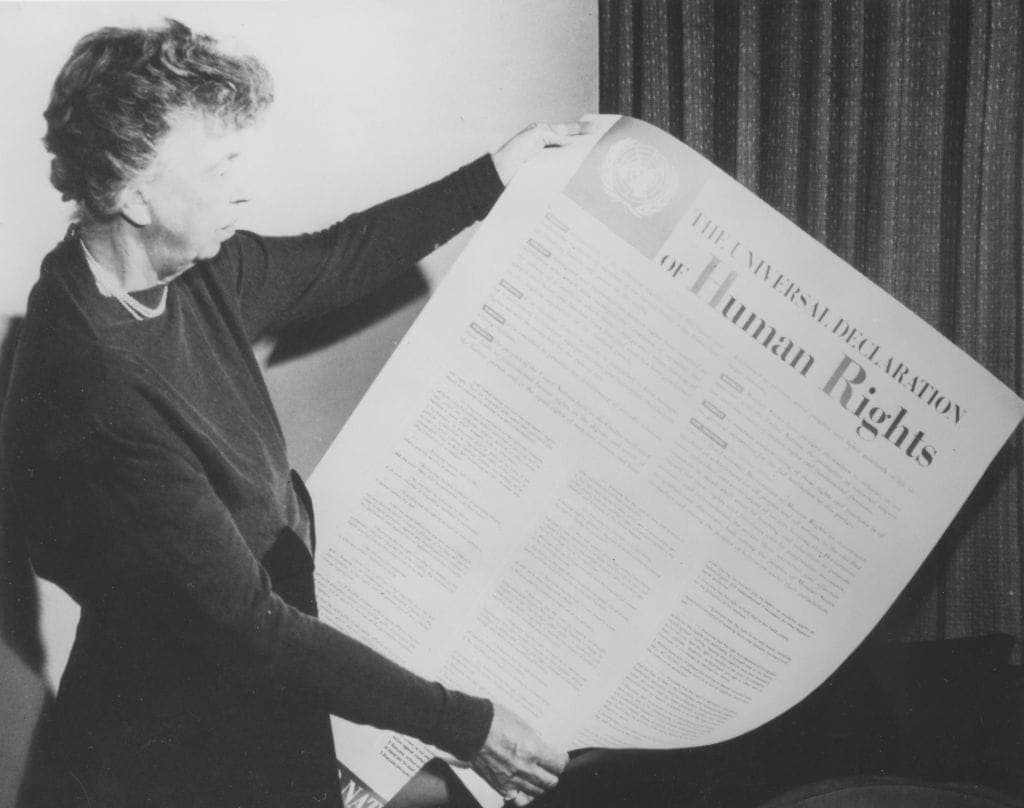
After her husband passed, Eleanor Roosevelt stoically left the White House. But her life did not stop at FDR’s death. It became even more important and came with a bigger stage on which she accomplished more lifelong goals. When Vice President Harry S. Truman became president, he had the good instinct to push Eleanor into a meaningful role: He appointed her a member of the first US delegation to the United Nations where she served as chairman of the Human Rights commission. He later bestowed the "First Lady of the World" nickname on Eleanor for her tireless work in human rights.
The Unsinkable Eleanor Roosevelt
Eleanor never really slowed down. She gained enjoyment and pride in being someone that “mattered.” In her book, You Learn by Living, she wrote: "You gain strength, courage and confidence by every experience in which you really stop to look fear in the face... You must do the thing you think you cannot do."
And to Aunt Edith: “That poor little soul grew up to become the best-known, and arguably most admired woman in America and really the whole world once upon a time.”