
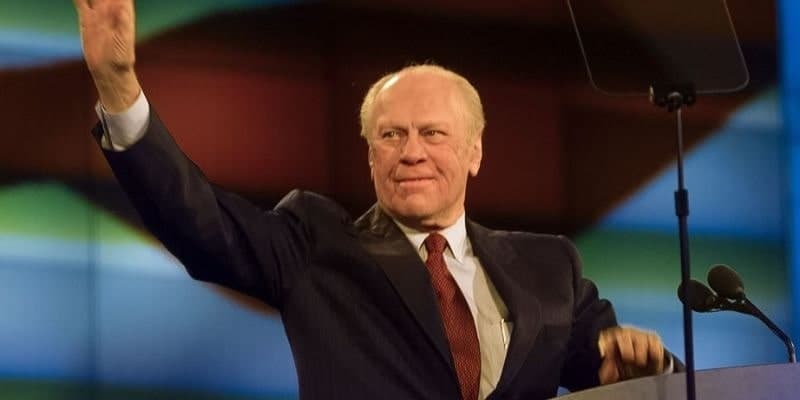
Though four other vice presidents had replaced presidents before him, Ford was often called the first unelected president because the people didn’t vote him into either office. Richard Nixon appointed him VP after Spiro T. Agnew resigned from the position. Then, he rose to the presidency after Richard Nixon resigned amid the Watergate scandal.
Gerald Ford and His Sudden Presidential Assignment
Before getting into politics, Gerald Ford was an athlete, studied law, and served in the Navy. In 1948, he was elected to the House of Representatives, where he continued to work for the next 25 years. He served on the Warren Commission, which investigated President John F. Kennedy’s assassination.
Gerald Ford thought of himself as “a moderate in domestic affairs, a conservative in fiscal affairs, and a dyed-in-the-wool internationalist in foreign affairs.” These ideals were going to be greatly challenged when he eventually took over the presidency.
As the Watergate scandal started hitting the headlines, Vice President Spiro T. Agnew resigned in October 1973. Although not a part of Watergate, the VP was accused of evading taxes and accepting bribes. President Nixon then appointed Gerald Ford as his new vice president, partially because of his popularity with the public. Mr. Ford took the office on December 6, 1973. But, just a few months later, on August 9, 1974, Nixon decided to resign (the only president to ever do so) instead of facing impeachment, catapulting Ford to America’s new leader.
This was a time when people’s trust in the government had been abused, and Ford had to try to find a way to heal the nation. In his inaugural address, the new commander-in-chief said, “Our long national nightmare is over. Our Constitution works. Our great republic is a government of laws and not men.” However, when he pardoned Nixon so the ex-leader would never have to face criminal charges, a lot of people were unhappy. Some suggest this is why Gerald Ford did not win his next official bid for president.
During the short two years of his presidency, Ford faced economic woes and a fear of recession. It didn’t help that he had to work with a Congress controlled by Democrats as a Republican president. His first goal was to find a solution for the inflation problems, which led him to use the power of presidential veto to prevent a lot of bills passed by Congress from becoming law.
Ford wanted businesses to operate with more freedom, and he reduced some of the taxes and controls that regulatory agencies had over them. “We … declared our independence 200 years ago, and we are not about to lose it now to paper shufflers and computers,” he said.
Gerald Ford ran for president in 1976 but lost to Democrat Jimmy Carter. During Carter’s inauguration speech, the new leader said, “For myself and for our Nation, I want to thank my predecessor for all he has done to heal our land.”
Ford retired from politics but continued to give speeches and stay involved by serving on boards and hobbies. He and his wife opened the Betty Ford Clinic in California to help provide treatment and research for alcohol addiction, which, at that time, was not considered a disease. In 1999, he received the Presidential Medal of Freedom, which is the highest civilian honor in America “awarded to individuals who make an especially meritorious contribution to the security or national interests of the United States, world peace, cultural or other significant public or private endeavors.”
Ford passed away on December 26, 2006, at the age of 93.
Test your knowledge: Take the quiz
Try a quiz based on this article
Gerald Ford was the _____ president of the United States.
Show the answer
38th.
Ford was born in Omaha, Nebraska on July 14, ______.
Show the answer
1913.
Gerald Ford was not elected for vice president or president.
Show the answer
True.
Ford took the place of ________ after the Watergate scandal.
Show the answer
Richard Nixon.
Ford worked for ______ years as a member of the House of Representatives.
Show the answer
25.
Vice President Spiro T. Agnew resigned because he was part of the Watergate scandal.
Show the answer
False.
Gerald Ford took Agnew’s place as vice president on December 6, ______.
Show the answer
1973.
Ford became president when Nixon ________.
Show the answer
Resigned.
Ford ran for president in 1976, but lost to _______.
Show the answer
Jimmy Carter.
The Betty Ford Clinic, ran by Gerald and his wife, helped to provide treatment for ________.
Show the answer
Alcohol addiction.