
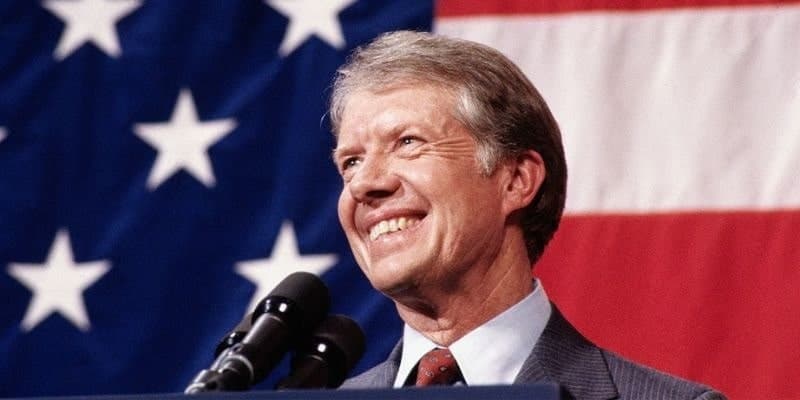
The 39th president of the United States, James Earl Carter, Jr., otherwise known as Jimmy Carter, was born on October 1, 1924, in Plains, Georgia. His family had a peanut warehouse business, which he took over after his father got sick. He dabbled in politics, slowly building his reputation, until he announced his candidacy for president in 1974. Carter campaigned for two years. He said he was running with a message of values, and he called for eliminating secrecy in government. Carter repeatedly claimed: “I’ll never tell a lie.”
President Jimmy Carter
Jimmy Carter held the office of president from January 20, 1977, to January 20, 1981. It was a rough time to run for office because the trust of the people had been sorely compromised and tested. Americans were still reeling from the Watergate scandal with President Richard Nixon, who resigned his office, making Gerald Ford the country’s president to not have been elected as either president or vice president. Carter, a Democrat, was able to beat Republican Ford in the 1976 presidential election, but his attempts at working with Congress were not as successful.
Even though the Democrats held the majority in both the House and the Senate, Congress still blocked many of Jimmy Carter’s proposals, including a welfare reform and a long-range energy program. Although he was popular and sought to portray himself as a man of the people by dressing casually and speaking less like a politician, his popularity took a hit when his friend, Bert Lance, whom he had named as director of the Office of Management and Budget, was accused of financial mischief. Even though Lance was later cleared, the damage had been done.
Jimmy Carter had some success in foreign affairs. He was able to broker two treaties with Panama, and his efforts during the Camp David Accords ended the war between Egypt and Israel. He also reopened negotiations with China. However, in 1979 the Iran hostage crisis happened as a mob of Iranian students took the diplomatic staff of the US embassy as hostages. Because he stood firm against demands and was not able to free the Americans, the public viewed his leadership as weak and inefficient. Although he ran for re-election in 1980, he lost to Republican Ronald Reagan. Ironically, Iran released the hostages on January 21, 1981, just one day after Reagan’s inauguration. The new president invited Jimmy Carter to go to Germany and meet the freed hostages.
After his presidency, Jimmy Carter continued his mission to broker peace in other countries. In 1994, he worked with North Korea to end the country’s nuclear weapons program, helped Haiti peacefully transfer government, and worked with the Bosnian Serbs and Muslims to create a temporary ceasefire. In 2002, the former president was awarded the Nobel Peace Prize for his work during the Camp David Accords as well as his post-presidential work bringing peace to other countries.
Test Your Knowledge – Take the Quiz
Try a quiz based on this article
James Earl Carter Jr. was the ____ president of the United States.
Show the answer
39th.
Carter was born on _______ 24, 1924.
Show the answer
October.
While campaigning, Carter repeated the words, “I’ll never tell a lie.”
Show the answer
True.
Jimmy Carter was president of the US from January 20, 1977, to January 20, ____.
Show the answer
1981.
Carter had a difficult time as president because Americans were still upset about Richard Nixon and the ________scandal.
Show the answer
Watergate.
Though the Democrats held the majority in the House and the Senate, Carter had difficulties getting proposals approved.
Show the answer
True.
Carter’s good friend, _______, caused trouble when he was accused of financial mischief.
Show the answer
Bert Lance.
Carter’s efforts during the Camp David Accords helped to end the war between Egypt and ______.
Show the answer
Israel.
Carter stood firm against the demands of the Iranian hostage-takers. The American public supported the president’s decision, overall.
Show the answer
False.
Who beat Carter in the 1980 presidential election?
Show the answer
Ronald Reagan.