
★ In this story 03
Welcome to New Hampshire, a state associated with the first American alarm clocks, where seat belts are not required for adults, and collecting seaweed at night is illegal. One of the original 13 colonies, New Hampshire was the first to adopt its own constitution and the ninth to ratify the US Constitution. There are thousands of miles of rivers and streams flowing through its gorgeous landscapes. Its motto, “Live Free or Die,” reflects New Hampshire’s spirit of independence, which was displayed during the founding of the United States.
400 Years of History
Before the start of the 17th century, New Hampshire was home to several Indigenous peoples that had inhabited the area for the previous 12,000 years. Between 1600 and 1605, European explorers began making their way to the New Hampshire area.
The colonial era began in 1623 with fishing and trading settlements near present-day Rye and Dover. Fishing, timber, farming, and shipbuilding led to great economic growth in the area. Massachusetts governed the settlements from 1641 until 1679, when New Hampshire became a separate royal province. Disputes over territories and colonial wars shaped its development until the American Revolution ended British rule.
An early act of rebellion during the American Revolution took place in New Hampshire’s Portsmouth Harbor. In December 1774, local patriots seized weapons and gunpowder from Fort William and Mary in New Castle several months before hostilities began at Lexington and Concord, which were the first battles in the American Revolutionary War. The gunpowder and weapons may have been used by the New Hampshire militia at the Battle of Bunker Hill, during the siege of Boston, MA, which was very costly for the British.
The Granite State became the first to adopt its own constitution on Jan. 5, 1776, and it ratified the US Constitution on June 21, 1788. Concord became the state's official capital in 1808.
From the 1950s to today, New Hampshire’s economy has shifted from traditional mill industries toward technology, healthcare, and educational services. Its population was about 1.42 million in 2025, up from around 533,000 in 1950. Much of the growth is attributed to highway expansion and stronger ties to the Boston, MA, metropolitan area.
A Changing Climate and Natural Landscape
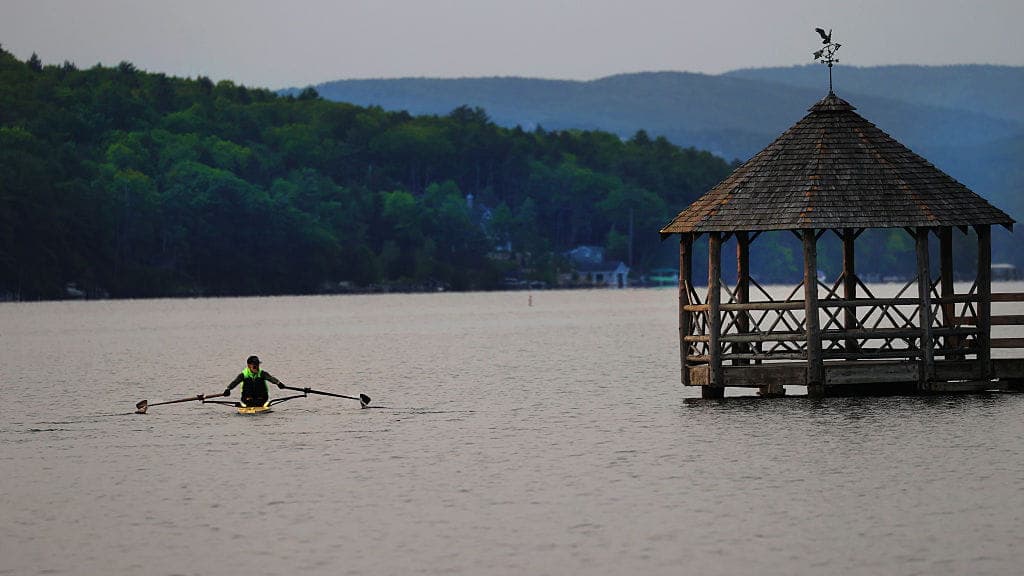
New Hampshire’s landscape offers a mix of alpine, forested, and water-based beauty, from the rugged White Mountains to rolling valleys, serene lakes, and beautiful coastlines. Some of the more popular places in the state are Lake Winnipesaukee and Jericho Lake. Both locations are surrounded by mountains and forests and are popular destinations for outdoor activities such as fishing, hunting, and hiking.
It got its nickname, the Granite State, because granite is practically everywhere in the landscape, from naturally occurring in the mountains and rocky soil, to being used in stone walls.
Granite is deeply woven into the physical landscape, appearing naturally in mountains, stone walls, and rocky soil
Its climate is classified as humid continental, which means the state experiences four seasons, including cold, snowy winters and hot, humid summers. The transition seasons of spring and fall offer varying but mild temperatures.
New Hampshire: Interesting Facts
From Marilla Ricker and humongous meatballs to the famous twentieth-century poet Robert Frost, New Hampshire brings a lot to the table. Marilla Ricker goes down in history as the first woman to attempt to vote in New Hampshire in 1870, before women had the right to vote, and the first woman to run for governor in 1910. The Nineteenth Amendment gave women the right to vote in 1920. Though she did not win since her name was not permitted on the ballot, her bravery and courage remain an inspiration today.
Moving on to giant meatballs. New Hampshire introduced the world’s largest meatball in 2009. Created by Matthew Mitnitsky, a 222.5-pound meatball took the record in both the Guinness Book of World Records. Several other massive meatballs have been created since. The latest known record holder came out of South Carolina in 2017 and weighed 1,707 pounds!
Robert Frost is famous for poetry that used everyday American speech and painted his works with images of familiar settings such as woods, snow, and stone walls. He was born in San Francisco, CA, married Elinor White in 1895, and then relocated to a farm in Derry, NH, in 1900. Today the Robert Frost Farm in Derry is a New Hampshire State Historic Site and a National Historic Landmark.
There is much to see and do in the nation’s 46th largest state.
4 Questions
The story, in brief
Why is New Hampshire called the Granite State?
New Hampshire is referred to as the Granite State in the title and is known for a spirit of independence captured by its motto, “Live Free or Die.” The state also has a varied natural landscape, including the rugged White Mountains, rolling valleys, lakes, and coastlines.
What role did New Hampshire play in the American Revolution?
An early act of rebellion happened in Portsmouth Harbor in December 1774, when local patriots seized weapons and gunpowder from Fort William and Mary in New Castle. This occurred months before the fighting at Lexington and Concord. The gunpowder and weapons may have been used by the New Hampshire militia at the Battle of Bunker Hill.
When did New Hampshire adopt and ratify the US Constitution?
New Hampshire became the first state to adopt its own constitution on Jan. 5, 1776. It later ratified the US Constitution on June 21, 1788. It was the ninth state to ratify the Constitution.
How has New Hampshire changed from the 1950s to today?
Since the 1950s, New Hampshire’s economy has shifted away from traditional mill industries toward technology, healthcare, and educational services. Its population grew from around 533,000 in 1950 to about 1.42 million in 2025. Much of that growth is linked to highway expansion and stronger ties to the Boston metropolitan area.

Kirsten Brooker
Culture Correspondent for Liberty Nation and Generation Liberty. Kirsten loves to write about culture from the point of view of an everyday American who lives deep in the heart of the Midwest. She is the mother of two adorable girls, likes classic rock, and humbly wears the crown of a former Homecoming Queen with grace and style.