
★ In this story 03
Have you ever heard the story of the beached, 45-foot sperm whale carcass that was blown to pieces with 20 cases of dynamite? The idea was to scatter the dead animal’s remains for birds to eat. But the explosion sent massive pieces of blubber flying through the air in all directions, and one crushed a car that was parked over a quarter of a mile away. This all took place on a beach near Florence, Oregon, in 1970. Sounds like a crazy story, doesn’t it? Well, it’s far from the only interesting story to come from the Union’s 33rd state. Continue reading to learn more about the great state of Oregon.
Oregon History
Records indicate that human activity in Oregon dates back around 14,000 years, and the evidence was found by archaeologist Luther Cressman in 1938. Cressman discovered the Fort Rock sandals, the oldest directly dated footwear ever found on Earth.
Several Native American tribes made their homes in Oregon, including the Bannock, Chasta, Chinook, Kalapuya, and Klamath tribes. These tribes lived throughout the region for thousands of years and developed rich cultures and advanced trading networks. European settlers began arriving in the area in the mid-16th century and were welcomed by Native Americans as they increased trade activity in the area.
Over the years, settlers from several countries made their way to the region. After becoming a US territory in 1848, Oregon joined the Union as the 33rd state on February 14, 1859. Statehood followed years of migration along the Oregon Trail, rapid population growth, and treaties that forced indigenous peoples to surrender much of their homelands.
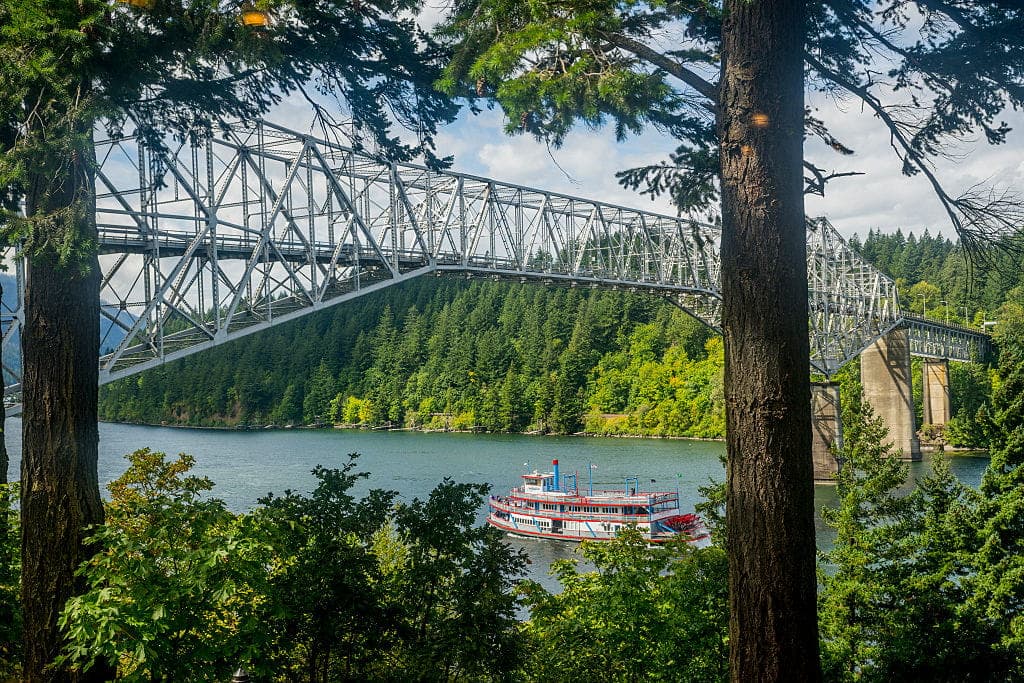
Throughout the 20th century, Oregon’s economy grew through timber, fishing, farming, manufacturing, and the expansion of cities such as Portland and Eugene. Hydroelectric dams on the Columbia River supplied power and supported industry. However, they also disrupted salmon runs and created problems for the native communities.
In the 1960s and 1970s, Oregon gained national attention for environmental policies that protected public beaches and oversaw urban growth. In recent decades, technology, health care, tourism, and outdoor recreation have become increasingly popular, while the state continues to face challenges regarding housing, wildfires, and climate change.
The Only State…
With 4.27 million residents, Oregon ranks 27th among the states by population and stands alone in several other categories.
· It is the only state with a two-sided flag; one side has the state seal, while the other side is a gold beaver.
· It is also the only state to have a fully public coastline. Thanks to Governor Tom McCall and his 1967 Beach Bill, every bit of the state’s 363-mile coastline is accessible to anyone.
· Until 2023, it was illegal to pump your own gas.
· Portland, the largest city in Oregon, had its name chosen by a coin toss in 1845.
· It is the only state with an official state nut: the hazelnut. Oregon grows 99% of all US hazelnuts.
· It was the only state in the contiguous US that was bombed by Japan in World War II.
· Tater tots, corn dogs, maraschino cherries, and the commercial barcode scanner were all invented or developed in Oregon.
Key Symbols
Since 1927, Oregon’s state bird has been the Western Meadowlark, a common songbird in the area. The state flower is the Oregon grape, an evergreen shrub native to the Pacific Northwest that produces edible berries. The North American beaver is the state animal and the source of Oregon’s nickname, the Beaver State. The state motto is Alis Volat Propriis, meaning “She Flies With Her Own Wings.” Oregon is the only state with a motto that, once translated to English, refers to the state as a female.
4 Questions
The story, in brief
When did Oregon become the 33rd state in the Union?
Oregon became a US territory in 1848 and joined the Union as the 33rd state on February 14, 1859. Statehood came after years of migration along the Oregon Trail, rapid population growth, and treaties that forced indigenous peoples to give up much of their homelands.
Why is Oregon called the Beaver State?
Oregon is called the Beaver State because the North American beaver is the state animal. The beaver is also featured on one side of Oregon's two-sided state flag, which is unique among the states.
What makes Oregon's coastline unique?
Oregon is the only state with a fully public coastline. Because of Governor Tom McCall and the 1967 Beach Bill, all 363 miles of the state's coastline are accessible to anyone.
What challenges does Oregon face today?
In recent decades, Oregon has seen growth in technology, health care, tourism, and outdoor recreation. At the same time, the state continues to face challenges involving housing, wildfires, and climate change.

Kirsten Brooker
Culture Correspondent for Liberty Nation and Generation Liberty. Kirsten loves to write about culture from the point of view of an everyday American who lives deep in the heart of the Midwest. She is the mother of two adorable girls, likes classic rock, and humbly wears the crown of a former Homecoming Queen with grace and style.