
★ In this story 02
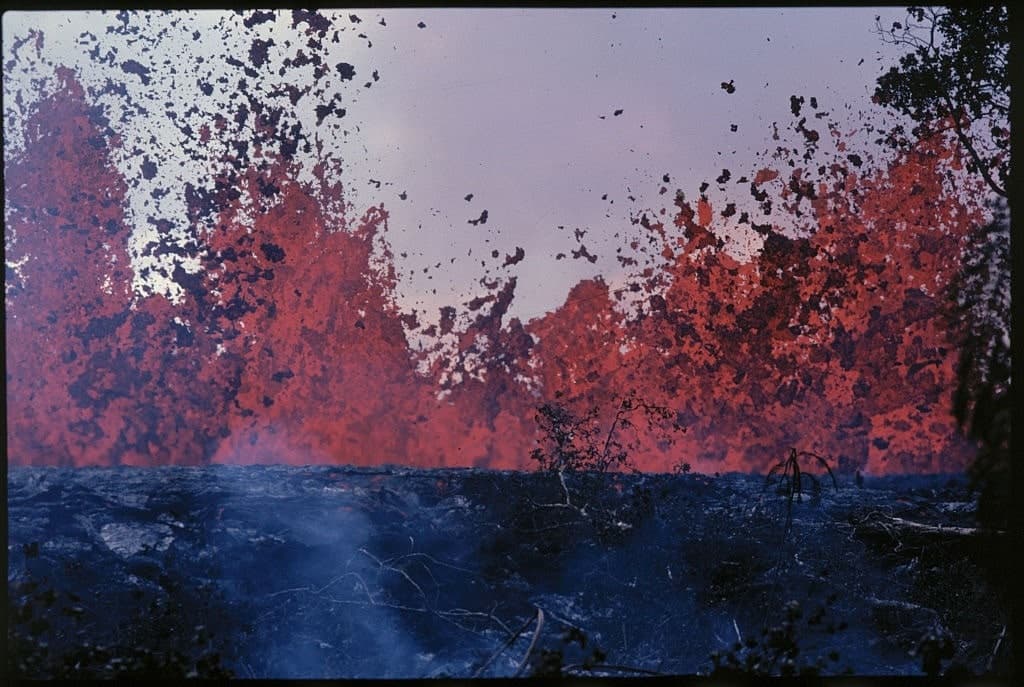
Imagine if asteroids, comets, and other extraterrestrial bodies constantly bombarded Earth, leaving no moon and very little – if any – atmosphere. Now imagine instead of water, our planet were covered in vast seas of molten rock, and any solid land that did exist didn’t last long. Welcome to the Hadean Eon, a time so violent, chaotic, and hot that it’s named for Hades, the Greek translation of the Hebrew word for hell, as well as the name of the god of the underworld and death.
The Mysterious Hadean Eon
As you may recall from the Geologic Time Scale, eons are the broadest category for classifying periods of Earth’s history. The Hadean Eon is the first of four, and the only one that isn’t further subdivided into Eras. Little is known about these early years, and this journey back through time, all the way to Earth’s beginning, involves the realm of speculation and theory.
There is little general consensus in the scientific community about the Hadean Eon, which ran from an estimated 4.6 billion years ago to about 4 billion years ago. There simply isn’t enough evidence left from that ever-changing time period of early Earth to prove anything, so educated guesses must be made in many cases to fill in the gaps.
For example, no one really knows when the outer crust or even the atmosphere came to be. Some believe that zircon was formed about 4.4 billion years ago, which would confirm the existence of solid land, liquid water, and surface temperatures below water’s boiling point. That said, many believe the atmosphere and the oceans didn’t form until toward the end of the eon.
But since those times, nearly all of the early crust was subducted – or pushed back into the mantle by the movement of the plates – and so very few rocks or minerals remain to be studied today. Scientists aren’t sure what the original atmosphere looked like, either. Many say it likely began as a region of hydrogen and helium escaping from the forming planet. Generally it’s believed that ammonia, methane, and neon were present as well. That’s a far cry from the nitrogen and oxygen mix we know today!
A Chaotic and Violent Beginning
Earth is believed to have formed through the accretion of dust and gases and the continual impacts of other bodies in space called planetesimals.
Early in the Hadean Eon and the first stages of Earth’s formation, convection currents in the mantle brought molten rock to the surface and caused cooling rock to sink into seas of magma. Through this process, heavier elements such as iron sank lower and became the core, while lighter elements, such as silicon, rose to the top and became part of the crust.
Much of the water on Earth is commonly believed to have come from icy comets hitting the young, unprotected planet. They would have evaporated on impact, and the clouds of vapor could have contributed to a thicker atmosphere and eventually to rain, which left deposits of liquid water on the surface. Even the moon is thought to have formed in the Hadean Eon. While several theories have been proposed, the leading option is that some other object about the size of Mars hit Earth. Some of the material became part of Earth, and the rest of it would have been ejected into orbit and coalesced to form the moon.
Earth in the Hadean Eon didn’t look much like it does today – or, for that matter, like it did for any of the other eons. But by the time the eon came to an end, scientists believe that Earth’s crust had cooled, the atmosphere had formed (though much thicker than today and lacking free oxygen), and the surface of the planet was covered in a global ocean with very little dry land – if any at all. From cosmic dust to oceans of molten rock to world of water, the Hadean was the most volatile and transformative eon in Earth’s history.
Test Your Knowledge – Take the Quiz
Try a quiz based on this article
The Hadean Eon got its name from the Greek translation of the Hebrew word “hell” and also from what Greek god that represents death?
Show the answer
Hades.
The Hadean is the only eon that is:
Show the answer
Not divided into eras.
Scientists believe that the Hadean Eon ran from about 4.6 billion years ago to 4 billion years ago.
Show the answer
True.
What word describes how the Earth’s crust was pushed back into the mantle by the movement of the plates?
Show the answer
Subducted.
Though scientists are not sure, many believe that the Earth’s atmosphere, at the beginning, was made up of:
Show the answer
Hydrogen and helium.
The continual impacts of bodies in space are called:
Show the answer
Planetesimals.
The moon is thought to have formed during the Archean Eon.
Show the answer
False.
The Hadean Eon was a time of cosmic dust to oceans of:
Show the answer
Molten rock.
One scientific theory suggests that an object roughly the size of Mars collided with Earth, with some of the debris becoming part of the Earth, and the other going into orbit and forming:
Show the answer
The moon.
After the Earth’s crust had cooled and the atmosphere had formed, the Earth was primarily made up of:
Show the answer
Water.