
★ In this story 03
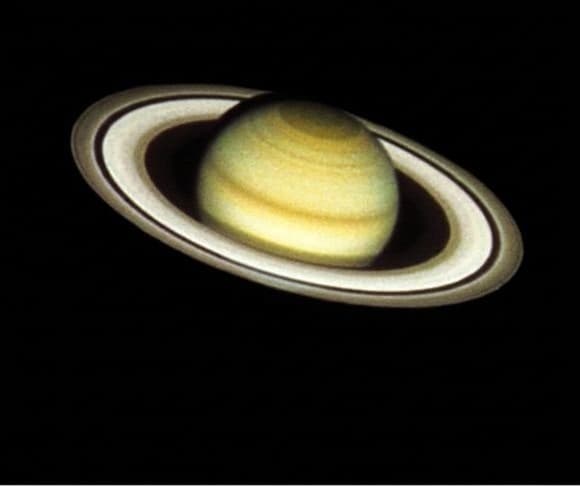
Out past Jupiter lies our solar system’s second largest planet, the gas giant Saturn. It is one of the most intriguing members of our system, with its most impressive – but not only – ring system and with its most moons. In addition, it’s the most reliable planet in our system, perhaps justifying the ancients’ belief that it represented the god of time.
Saturn – The Source of Measure
In 1997, Bernard Pietch, an archaeo-meterologist and independent researcher, penned a poem dedicated to the sixth planet from the sun:
From all the legends since the days of yore
Saturn, old Chronos, will tell us more.
The measure in the cadence beat
in sound and light makes all compleat!
Saturn, source of measure.
He went on to write that Saturn is the “most rigorous, most regular and the most stable in its orbit.” Its path around the sun shows the least amount of variation, and it seems more capable than any other planet of ignoring or absorbing the effects of other objects in space that come near it.
The Bringer of Old Age
This consistency is much more easily measured with modern technology, but it was observed even by the ancient, pre-telescope astronomers, and it has been long used by ancients and moderns alike as the standard against which they measured the timing of the solar system. It’s no wonder, then, that the Greeks and Romans called the planet Chronos and Saturn after their respective gods of time.
In Gustav Holst’s collection of musical compositions, “Saturn, the Bringer of Old Age” is the fifth of seven. The piece features a slow, ticking-clock rhythm at the beginning, then a heavy, solemn march, followed by a powerful, climactic section that ultimately fades away – dynamics designed to depict the journey of life toward old age.
A World of Wonders
As the second largest planet in the solar system, Saturn is about 860 times the size of Earth, while Jupiter could fit 1,400 Earths inside it – or, alternatively, all of the other planets in our system combined, including Saturn.
Saturn stands out primarily because of its rings, a wide, thin disk of particles – mostly water ice and dust – that orbits the planet. The ring system is somewhere around 150,000 miles wide, but only about 10 feet thick in many places. Saturn orbits at an average 886 million miles out from the sun – almost 10 times farther than Earth – and it completes one circuit in about 29 Earth years. A full day (one rotation around its axis) is just 10 1/2 Earth hours.
As of the latest count, Saturn has 274 confirmed moons, far more than any other planet in the solar system. The runner-up, Jupiter, has 95. Two of those, Enceladus and Titan, are believed to be potentially capable of supporting life as we know it. Both feature large subsurface oceans of saltwater, though if any life does already exist there, it’s likely sparse.
So far, only unmanned space probes have flown by Saturn and its moons. The Pioneer 11 and the Voyager 1 and 2 spacecraft, as well as the Cassini-Huygens mission, which orbited the planet and deployed a lander to Titan, are responsible for much of what we know of Saturn. Sometime this decade, another mission is planned to send a rotorcraft to explore Titan’s surface, though it would take close to a decade for it to arrive. There aren’t any major plans for humans to visit any time soon – but if the robot explorers send back promising data, all that could change!
Try a quiz based on this article
The gas giant, Saturn, is the _______ planet in our solar system.
Show the answer
Second largest.
Ancient people believed that Saturn was the god of:
Show the answer
Time.
What archaeo-meteorologist wrote a poem dedicated to Saturn in 1997?
Show the answer
Bernard Pietch.
The name of the Roman god of time is Saturn. What is the Greek name for the god of time?
Show the answer
Chronos.
Saturn is approximately 860 times the size of Earth.
Show the answer
True.
What feature makes Saturn stand out?
Show the answer
Its rings.
Saturn has 274 confirmed moons, more than any other planet. Which planet comes second with 95 moons?
Show the answer
Jupiter.
Which two of Saturn’s moons are believed to be capable of supporting life?
Show the answer
Titan and Enceladus.
Several manned spacecraft have closely orbited the surface of Saturn.
Show the answer
False.
There are plans in the next decade to send a rotorcraft to more closely explore Saturn, though, once launched, it will take the craft nearly ______ to reach the planet.
Show the answer
Ten years.