
★ In this story 03
What is your favorite part of the school day? Many would likely answer recess or gym class. But why? For animals and humans alike, playtime is a crucial part of development, exploration, and education – not to mention, it is fun! Animals use play to practice real-life situations like hunting and surviving against predators. Studying why and how animals play gives insight into why it also benefits humans.
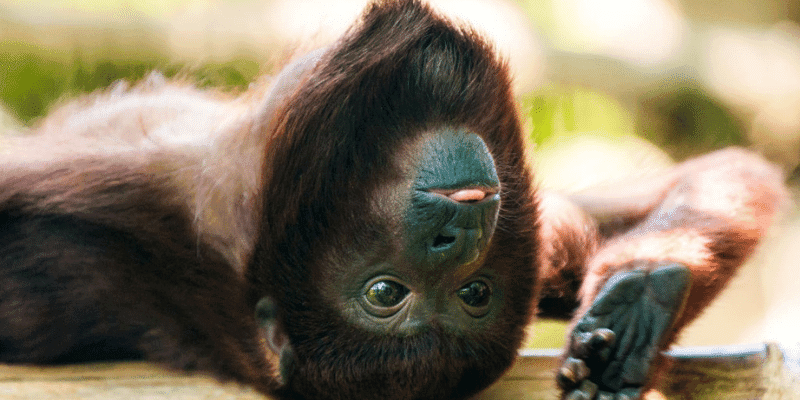
The howler monkey is one animal that uses play as a powerful tool, a recent study found. The research showed that the monkeys play together as a way to reduce fighting in their communities.
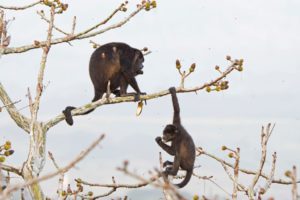
Howler Monkeys Play to Resolve Conflict
Groups of howler monkeys living in Costa Rica and Mexico have been the focus of scientific study. The researchers noticed that the primates engaged in playful activities when there was conflict within the group. The active creatures hang from trees and even make silly faces at each other.
The playfulness between the monkeys seems to increase in tense situations like finding fruit, as it is a highly prized food source. It takes a lot of energy to play, especially since the howler monkeys mostly eat leaves – a low source of energy. Fruit gives them more stamina than other available foods. The monkeys compete to get this delicious treat, so they resort to silly behaviors to reduce tension between one another.
“Despite its appearance and our own perception of what play means, play is not always associated with frivolity or education. Instead, we think it fulfils an important function in howler monkey society by reducing tension when there is competition over scarce resources,” said Dr. Jacob Dunn, a professor at Anglia Ruskin University.
Playfulness in Other Animals
Dogs, cats, and many other animals are often very playful. Kittens romp around all day, pouncing on and batting at anything in their path. But is it just for recreation? Some researchers feel there may be more to it than that. For example, a cat pouncing on an inanimate object looks fun, but perhaps the animal is working on its hunting skills. Two dogs frolicking and wrestling in the grass appears to be playfulness, but maybe they are establishing which dog is the dominant one.
Animals, particularly those in the wild, constantly face dangerous situations. Predators lurk around nearly every corner, rough terrain and bad weather cause problems, and the constant pursuit of a meal leaves them very little time for fun. So could it be that the animals play to relieve the stresses and anxieties of their daily lives? Researchers think it is a combination of stress relief and practice for future life challenges.
Why Do Humans Play?
Humans of all ages participate in some sort of play. From babies to adults, humans are always looking for something to satisfy their desire for fun. As a result, children spend much of their day playing with toys or other kids. They might use their imagination to pretend they are someone or something else. It may seem like useless fun, but the children are gaining valuable skills from their playful antics. It can teach them how to socialize with other people, as well as developing their bodies and brains. These skills are improved just by participating in spirited fun.
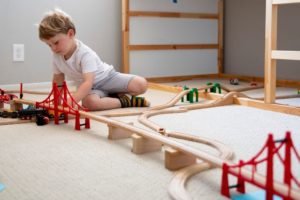
Adult play differs from a child’s, but it is still a large part of life. Grown-ups may not want to play with dolls or pretend they are a spaceship, but many take part in playful activities like sports, video games, puzzles, and much more.
It is a key part of life for all mammals to interact with others and engage in playful behaviors. This need is not learned, but is in our nature. The benefits of playtime are great, so find something fun to do!
Try a quiz based on this article
Playing has benefits for both animals and humans.
Show the answer
True.
Howler monkeys use playtime to reduce ______.
Show the answer
Conflict.
Fruit gives howler monkeys more ______ than the typical leafy greens they eat.
Show the answer
Energy.
Playfulness in animals can be practice for real-life situations like hunting.
Show the answer
True.
Which is the best example of an inanimate object?
Show the answer
A tennis ball.
Playing, for children, is a useful tool in building social skills. It also helps to develop the body and ______.
Show the answer
Brain.
Scientists recently studied the monkeys in which country? Check all that apply.
Show the answer
Costa Rica.
Competition between monkeys could arise when food is scarce. How do they deal with this situation?
Show the answer
Playing.
Only kids have fun, adults never engage in play.
Show the answer
False.
Which answer best defines "frivolity"?
Show the answer
something carefree; without a serious purpose.

Kirsten Brooker
Culture Correspondent for Liberty Nation and Generation Liberty. Kirsten loves to write about culture from the point of view of an everyday American who lives deep in the heart of the Midwest. She is the mother of two adorable girls, likes classic rock, and humbly wears the crown of a former Homecoming Queen with grace and style.