
★ In this story 02
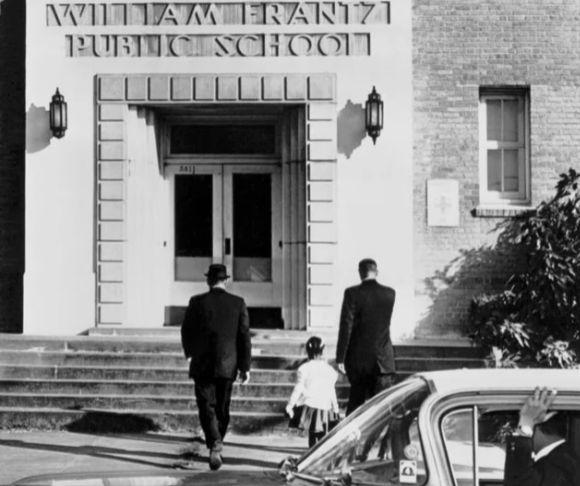
At first glance, the photograph captures an ordinary school day: two men escorting a young girl into a school building. This picture, however, captures a significant turning point in US history. The scene took place during the Civil Rights Movement in the mid-20th century, when blacks fought to end racial segregation and secure equal rights.
The picture shows six-year-old Ruby Bridges being escorted into Louisiana’s William Frantz Public School by federal marshals on Nov. 14, 1960. Ruby was the first black child to attend that formerly whites-only elementary school. Because of the violent, hostile crowds and opposition to the law change, even at the state level, Ruby’s life was constantly threatened. The marshals escorted her to help ensure her safety.
The Civil Rights Movement
The Civil Rights Movement (1954 to 1968) was a trying time for people of color, especially in the South. Through peaceful protests, marches, and court cases, leaders like Martin Luther King Jr. and Rosa Parks, along with many others sympathetic to their cause, struggled to end racial segregation and discrimination. Their efforts led to major achievements, such as the Civil Rights Act of 1964 and the Voting Rights Act of 1965, which strengthened legal protections against racial discrimination.
These victories, however, did not come overnight. Years earlier, a landmark court case had already set the stage for change.
In 1954, less than four months before Bridges was born, the Supreme Court ruled in Brown v. Board of Education that racial segregation in public schools was unconstitutional. Southern states remained extremely resistant to the decision and fought against integration. Some state governments actively resisted desegregation.
Bridges was one of six black children to attend all-white schools. Children were given a test, designed to be difficult, and only six were able to pass. Of the six, two chose to remain at their old school, three of them were transferred to the all-white McDonogh No. 19 Elementary School, and Ruby alone was transferred to Frantz.
As Bridges described her experience, "Driving up I could see the crowd, but living in New Orleans, I actually thought it was Mardi Gras. There was a large crowd of people outside of the school. They were throwing things and shouting, and that sort of goes on in New Orleans at Mardi Gras."
Ruby’s First Day
Once she entered the building, Ruby witnessed the parents of the white children pulling their kids out of school. All but one of the teachers refused to teach with a black student enrolled. The brave one who chose to stay was Barbara Henry from Boston. Throughout Ruby's first school year, Henry taught her in an otherwise empty classroom, giving her the same instruction she would have provided to a full class.
Before lessons could begin, though, Ruby spent her first day in the principal’s office with her mother. It was too chaotic and dangerous for her to be in the hallways or the classrooms. Ruby faced terrifying threats, had to be brought a special lunch that wasn’t tampered with, and wasn’t allowed to participate in recess. Her family faced immense backlash: Her father lost his job, and her grandparents, who were sharecroppers in Mississippi, were forced off their land.
Ruby recalls receiving support from community members, both black and white. Some white parents showed support by continuing to send their kids to Frantz, while others protected the Bridges’ home and walked behind the federal marshals’ cars as they transported little Ruby to school each day.
Ruby Bridges grew up to devote her life to her people, becoming a civil rights activist, author, and advocate for educational equality.
4 Questions
The story, in brief
Who was Ruby Bridges at William Frantz Public School?
Ruby Bridges was a six-year-old girl who became the first black child to attend Louisiana's William Frantz Public School. She entered the formerly whites-only elementary school on Nov. 14, 1960, escorted by federal marshals during the Civil Rights Movement.
Why did federal marshals escort Ruby Bridges to school?
Federal marshals escorted Ruby Bridges because Southern resistance to school integration was intense and the situation was dangerous. A large hostile crowd gathered outside the school, and Ruby later faced threats serious enough that she needed a special lunch and was kept out of recess.
How did William Frantz Public School respond to Ruby Bridges?
When Ruby Bridges arrived, parents of white children pulled their children out of the school. All but one teacher refused to teach with a black student enrolled, and Barbara Henry taught Ruby alone in an otherwise empty classroom during her first school year.
What happened to Ruby Bridges and her family after integration began?
Ruby Bridges endured threats and spent her first day in the principal's office because conditions were too chaotic for classes. Her family also suffered backlash, her father lost his job and her grandparents were forced off their land, but some black and white community members supported them and helped protect Ruby.

Kirsten Brooker
Culture Correspondent for Liberty Nation and Generation Liberty. Kirsten loves to write about culture from the point of view of an everyday American who lives deep in the heart of the Midwest. She is the mother of two adorable girls, likes classic rock, and humbly wears the crown of a former Homecoming Queen with grace and style.