
★ In this story 03
Look at a quarter or a dollar bill, and you’ll see a phrase most Americans can translate without trouble: E PLURIBUS UNUM, Latin for “Out of many, one.” The nation’s first official motto, what does it mean? Today, many people think it describes the United States as a “melting pot,” how millions of people from different backgrounds, cultures, languages, and regions of the globe all came together to form a single, united American society.
That’s an inspiring sentiment, but it turns out to be historically incorrect.
When the Continental Congress commissioned three of the most famous men in the world to pick a national motto for the new nation in the summer of 1776, they weren’t writing poetry about cultural assimilation. They were trying to solve a practical dilemma: How do you take 13 fiercely independent, suspicious, and argumentative colonies and meld them into a single unified Republic before the British Empire hangs everyone for treason?
The Committee of Three and an Overworked Artist
Once the Declaration of Independence was adopted on July 4, 1776, the members of the Continental Congress realized they had another problem: branding. They had just declared themselves a sovereign nation. But they didn’t have a seal, a coat of arms, or a motto to stamp on treaties, legal decrees, and passports.
Congress appointed the Committee of Three to sort out these remaining bits. Benjamin Franklin, Thomas Jefferson, and John Adams were given the task. You might think such intellectual heavyweights would have it done by suppertime. Instead, they hit a creative wall.
Franklin wanted a dramatic biblical scene depicting Moses parting the Red Sea with Pharaoh’s army drowning in the background and the fiery motto: “Rebellion to Tyrants is Obedience to God.” Jefferson liked the general idea but suggested that, instead of the Red Sea scene, they have the Israelites marching through the wilderness led by a cloud by day and a pillar of fire by night.
Yet Adams preferred classical Greek mythology. He proposed having Hercules standing between two figures representing Virtue and Sloth.
None of these designs, you might have noticed, are what finally made the cut.
The three also realized they didn’t know anything about drawing heraldry. So, they brought in a Swiss-born portrait painter named Pierre Eugène du Simitière. It was he who suggested the foundational motto that survives to this day: E Pluribus Unum.
Who Are the One and the Many?
Latin was the shared language of educated gentlemen in the 18th century, and variations of this phrase had appeared in the writings of Roman authors such as Horace, Virgil, and Cicero. More immediately for the Founders, though, it appeared every month on the title page of London’s The Gentleman’s Magazine, a popular British publication that collected essays, poems, and debates from many other publications into one. It advertised itself with the phrase E Pluribus Unum to mean one magazine made of many articles.
In the early days of the Republic, Americans didn’t see themselves as Americans, rather as citizens of their states – and the states were united in friendship but otherwise sovereign. “Americans” were Virginians, North Carolinians, Pennsylvanians, and so forth.
These colonies had vastly different economies, religions, local laws, and even founding ideals. They spent decades bickering with one another over borders, trade tariffs, and river rights. In practice, they distrusted each other nearly as much as they distrusted King George III in England. The Declaration of Independence announced the existence not of a single nation but the 13 united States of America. The plural was intentional, as was the lack of capitalization on united. At the time, that was an adjective describing the states, not part of the formal name of a nation (not until the Articles of Confederation, anyway).
Pluribus, the many, represented not individual citizens, but the 13 distinct, sovereign states. Unum, the one, was the fragile and at the time, unprecedented federal framework being built just to manage the common defense, foreign diplomacy, and commerce for them.
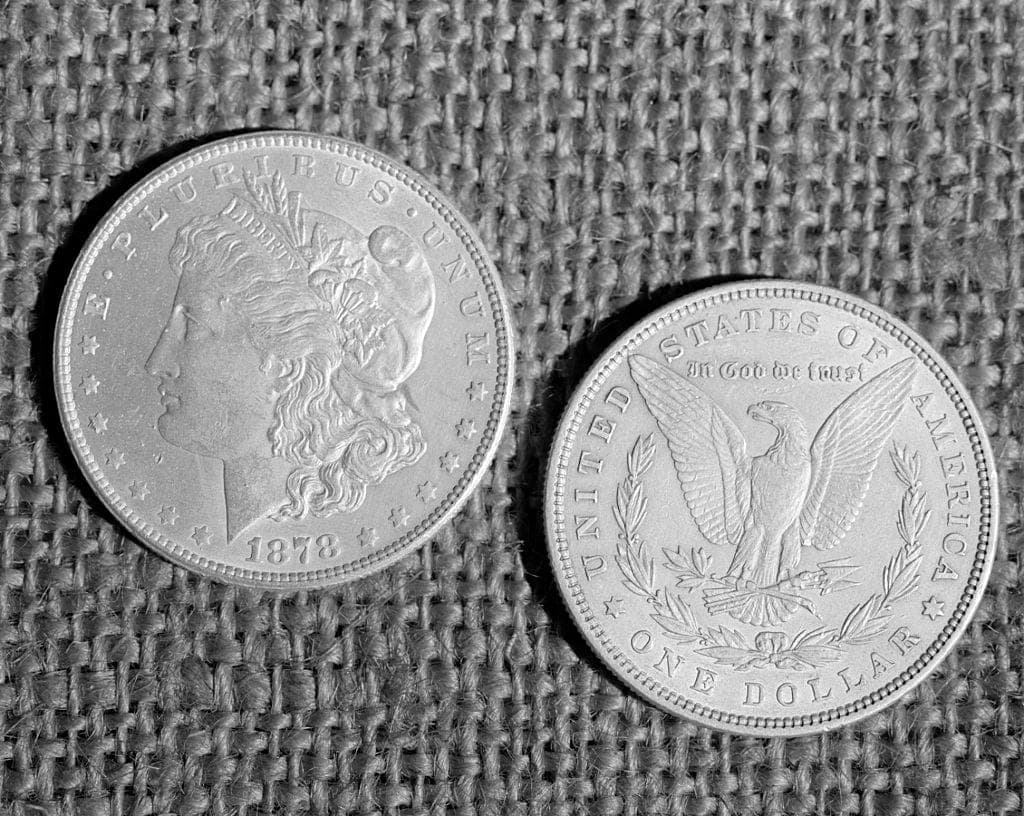
Congress didn’t adopt the design right away. The war got in the way. The Great Seal was approved in 1782. It showed an eagle holding a bundle of 13 arrows in one talon and an olive branch with 13 leaves and 13 olives in the other, and clutching in its beak a ribbon bearing the motto E PLURIBUS UNUM. It wasn’t until 1795 that the phrase appeared on the first coin, and it wasn’t mandatory on all US currency until 1873. Congress officially made “In God We Trust” the national motto in 1956, but E Pluribus Unum remains the historic icon describing the American political structure.
E Pluribus Unum – A Fragile Balance
Understanding what the Founding Fathers meant by E Pluribus Unum is more than just an exercise in trivia. It goes to the very heart of the American constitutional principle: federalism. And it’s a delicate balance.
If the Unum swallows the Pluribus, the system breaks. And this is the tendency government has over time – to grow in size and power and swallow up liberty and individuality in the name of security. Top-heavy, massive national governments that hold all the power exist all over the world and did at the time of the founding as well. This was the primary situation the Founders hoped to avoid.
But the Pluribus could overwhelm the Unum, too, if the states fail to cooperate and the union collapses into squabbling regional factions unable to protect their borders or maintain a stable economy. This almost destroyed the young United States under the Articles of Confederation.
E Pluribus Unum was never a demand for people to think, speak, or live alike. It was never a “melting pot” decree. Rather, it was a declaration that distinct, self-governing communities could unite under a single constitutional umbrella for mutual liberty while maintaining their own identities.
4 Questions
The story, in brief
What did E Pluribus Unum originally mean in early America?
It originally referred to the political union of the 13 distinct, sovereign states, not to people from many cultures blending into one society. Pluribus meant the many states, and Unum meant the fragile federal framework created to handle common defense, diplomacy, and commerce.
Who suggested E Pluribus Unum for the new United States?
The phrase was suggested by Pierre Eugène du Simitière, a Swiss-born portrait painter brought in by Benjamin Franklin, Thomas Jefferson, and John Adams. The three founders had struggled to agree on a design and realized they did not know how to draw heraldry.
Why did the Founders choose E Pluribus Unum in 1776?
The Continental Congress needed a seal, coat of arms, and motto after declaring independence and becoming a sovereign nation. The phrase addressed a practical problem, how to unite 13 fiercely independent colonies into a single republic before their new union fell apart or was crushed by Britain.
How did E Pluribus Unum appear on the Great Seal and US money?
The Great Seal was approved in 1782 with an eagle holding 13 arrows and an olive branch, while a ribbon in its beak carried E Pluribus Unum. The phrase appeared on the first coin in 1795, became mandatory on all US currency in 1873, and remained a historic national icon even after Congress made In God We Trust the national motto in 1956.