
★ In this story 02
Turn 18 in the United States, and you unlock a right of citizenship that serves as a rite of passage that has kept our country running for more than two centuries. But the rules for voting are different in each state, and the process of filling out ballots isn’t typically taught in high school or demonstrated on TV.
So, what are these odd sheets of paper called ballots, and how do you fill them out to represent your electoral choices? Well, the bad news is that varies by state – but the good news is it isn’t nearly as complicated as it may seem the first time you show up to vote.
Ballots Across the Nation
Every two years, you may walk into a polling place for federal elections. Congress chose the first Tuesday after the first Monday in November (this year Nov. 3) as the day when voting will occur, for president and for the midterms, which happen in the middle of a presidential term.
Walk into a polling place, and you’ll likely be handed a piece of paper that might look like a standardized test. Or maybe it’s a blank form without candidates printed on it at all, just the precinct information.
If your area uses voting machines, you’ll likely be handed a piece of paper that you insert into a slot in the machine. Then you follow on-screen prompts to make your choices, review those choices before finishing, then hit print to have it spit that sheet of paper back out, complete with your choices printed clearly on it. Then you insert it into the machine that logs and counts the votes, and you’re done!
If you live in one of the many states that has voters fill out paper ballots by hand, what you get will probably look more familiar. You’ll have a sheet of paper with each office and candidate listed with a box or bubble next to their names. You mark the one you want to vote for, of course, just like picking your answer on a multiple-choice test. When you’re done, in this case, you might hand your ballot in to a person, just like turning in a test at school. Far more likely, you’ll feed your ballot into a machine that reads and counts the vote.
Think of Election Day not as a single federal election carried out in 50 different states and Washington, DC, but 51 separate elections entirely. That’s why things can be so different. The US Constitution mostly leaves it up to the states to regulate their elections, even for federal offices. But the good news is that, different though it may be from one state to the next, it really is a simple process most of the time.
The Anatomy of a Ballot
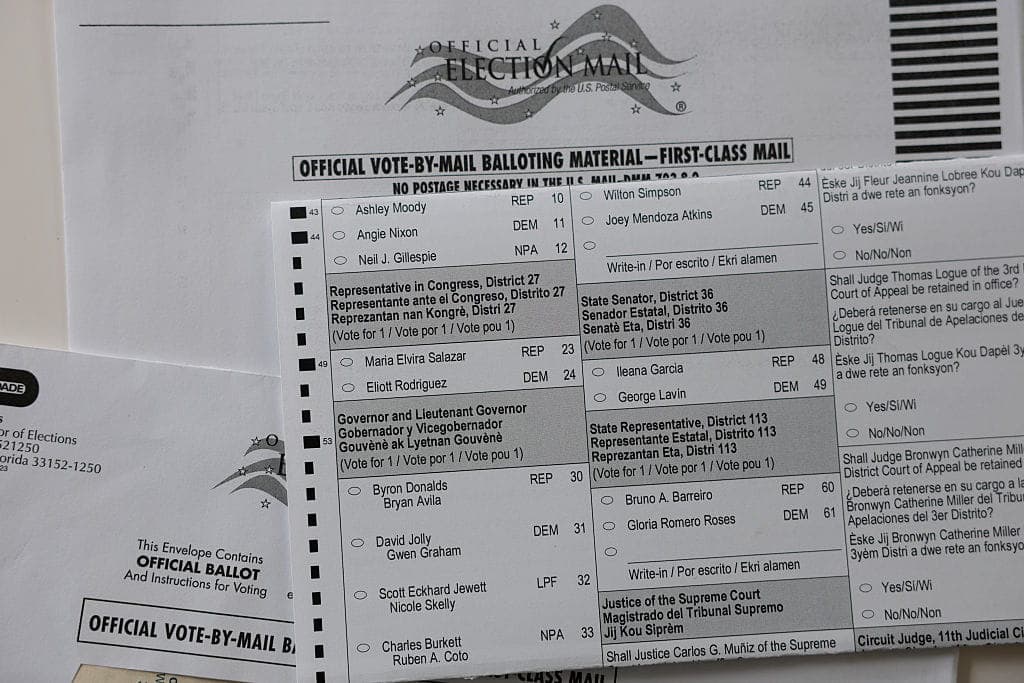
Every ballot – whether filled out manually or printed by a machine – will include the same information, even if it looks a little different in varying locations. The very top includes the precinct data and often instructions for how to fill it out. Here’s an important note on hand-marked ballots – the instructions matter. If it says to fully fill in the bubble or draw an X in the box, and instead you circle the name or doodle something in the margins, it can confuse the vote count (especially if that part is done by machine). Here’s a tip: If you make a mistake, ask a poll worker for a fresh ballot to start over.
When it comes to making your choices, the ballots are split into sections. The big headline-grabbing races that dominate the news usually appear first: the federal offices. Here you will see the candidates running for US House of Representatives to represent your district and, in most years, the US Senate for your state. And if it’s a presidential election, you’ll see candidates for president and vice president as well.
Moving down the page, you’ll find the state executive and legislative races. These might include governor and lieutenant governor, attorney general, secretary of state, treasurer, land commissioner, and any other executive office your state chooses by election. It will also include anyone running for the state legislature.
Then you get to the local, down-ballot races. A lot of voters who aren’t particularly engaged tune out before they ever get here – but that’s a mistake. This is where daily life happens. This is the section of the ballot that determines who runs your city, sits on your local school board, leads the county sheriff’s department, decides how local laws are enforced and prosecuted, and makes sure the potholes in the road get fixed, among countless other local tasks that might seem small but are crucial to daily life in a community.
Finally, you’ll find the ballot issues, if there are any. This is direct democracy at work. Rather than the legislature passing laws, some issues end up on the ballots for voters to decide directly. Frequently these will be local tax issues or state constitutional amendments.
Voting can be intimidating for a number of reasons when you first get started – but you don’t have to wait until Election Day to see a ballot. Wherever you live in the United States, your state and perhaps even county will maintain a website that gives election information. If you’re unsure what office runs the elections where you live, visit vote.gov, which links to the official sites for every state.
When and where can you vote? These websites will tell you! Want to research candidates or ballot issues ahead of time or want to see what the ballot will look like before you show up? In most places, you can enter your address and get a sample ballot. Other than being clearly marked as a sample, it will look mostly like what you’ll see either on the paper they hand you or on the screen of your voting machine. Knowing how ballots are organized and what’s on them before you step behind the curtain turns voting from a mysterious and confusing chore into an easy exercise in self-governance.
4 Questions
The story, in brief
What is a ballot in a United States election?
A ballot is the paper voters use to record their choices in an election, whether they mark it by hand or print it from a voting machine. It includes precinct information, instructions, and sections for federal, state, local races, and sometimes ballot issues for voters to decide directly.
How do voters fill out a ballot at a polling place?
In places that use voting machines, voters insert a paper into the machine, follow on-screen prompts, review their choices, and print the completed ballot before it is counted. In places that use hand-marked ballots, voters mark the box or bubble next to their chosen candidate, then return the ballot to a poll worker or feed it into a counting machine.
Why do ballots and voting rules vary by state in the United States?
Ballots and voting procedures differ because the United States Constitution mostly leaves it to the states to regulate their elections, even for federal offices. The result is not one single national election system, but 51 separate elections across the states and Washington, DC.
How can voters preview a ballot before Election Day?
State and sometimes county election websites provide election information, including when and where to vote. In most places, voters can enter their address to get a sample ballot, which is clearly marked as a sample but looks mostly like the ballot or voting screen they will use.