
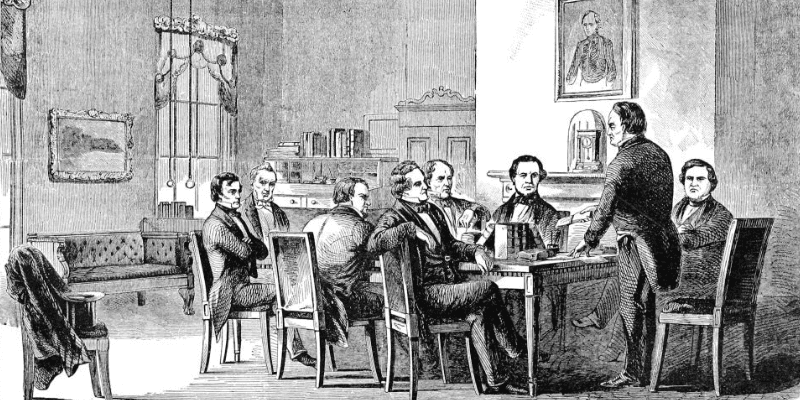
Buchanan’s political career began with his service in the Pennsylvania legislature from 1814 to 1816. He then served from 1820 to 1830 in the U.S. House of Representatives. In 1831, President Andrew Jackson appointed the young politician as the U.S. ambassador to Russia, where he succeeded in negotiating with the country for a trade and maritime agreement. After working in Europe, Buchanan returned home in 1834 and was elected to represent Pennsylvania in the U.S. Senate. When President James Polk appointed him to the position of U.S. secretary of state, he resigned his Senate position.
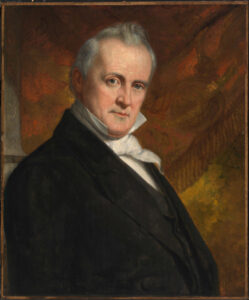
Buchanan was personally against the institution of slavery but still felt it was each state’s decision on whether to allow it. In 1846, he supported the Southerners and blocked the Wilmot Proviso, which would have banned slavery in any territory obtained from Mexico during the War. He then backed the Compromise of 1850, which allowed new western territories to decide whether they wanted to allow slavery.
President Franklin Pierce appointed Buchanan as the minister to Great Britain in 1853. Pierce loss his popularity after signing the Kansas-Nebraska Act in 1854, which ultimately led to the extreme fighting between Kansans who disagreed on the issue of slavery, resulting in the state nickname “Bleeding Kansas.” Because of this act, the Democrats chose not to nominate him for the next presidential election and, in 1856, chose Buchanan instead.
Tensions between the mostly anti-slavery North and the mostly pro-slavery South intensified greatly during Buchanan’s presidency. The Supreme Court handed down the controversial Dred Scott decision, which said the government did not have the power to regulate slavery. Abolitionist John Brown led an uprising and attempted to take the federal arsenal in Harpers Ferry, which resulted in Brown’s hanging.
Buchanan, keeping his campaign promise, did not run for re-election in 1860, and Abraham Lincoln was voted as the next president of the United States. Southerners did not take kindly to Lincoln’s victory, and South Carolina seceded from the Union on Dec. 20, 1860. By the time Lincoln was inaugurated on March 4, 1861, Alabama, Florida, Georgia, Louisiana, Mississippi, and Texas had also seceded and formed the Confederate States of America.
The Civil War began barely a month later, on April 12, 1861, as Confederate forces fired on Fort Sumter in South Carolina.
Buchanan had returned to his home, where he died on June 1, 1868 at the age of 77.
Test Your Knowledge – Take the Quiz
Try a quiz based on this article
James Buchanan, the 15th president of the United States, was born in:
Show the answer
Pennsylvania.
What president, in 1831, appointed Buchanan as the US ambassador to Russia?
Show the answer
Andrew Jackson.
Buchanan was personally against the institution of slavery.
Show the answer
True.
What is the name of the amendment that would have banned slavery in territories acquired by Mexico during the Mexican-American War?
Show the answer
The Wilmot Proviso.
What US president was blamed for the fighting between Kansas and Nebraska in 1854?
Show the answer
Franklin Pierce.
In what year was Buchanan elected the president of the United States?
Show the answer
1856.
What nickname did Kansas earn after the extreme fighting over slavery with Nebraskans?
Show the answer
Bleeding Kansas.
The controversial decision passed down from the Supreme Court that said the government did not have the power to regulate slavery is known as:
Show the answer
The Dred Scott Decision.
Several states seceded from the Union after Abraham Lincoln was elected president, including which of the following?
Show the answer
South Carolina.
What is the name of the war that began on April 12, 1961, between the North (Union) and South (Confederacy)?
Show the answer
The Civil War.