
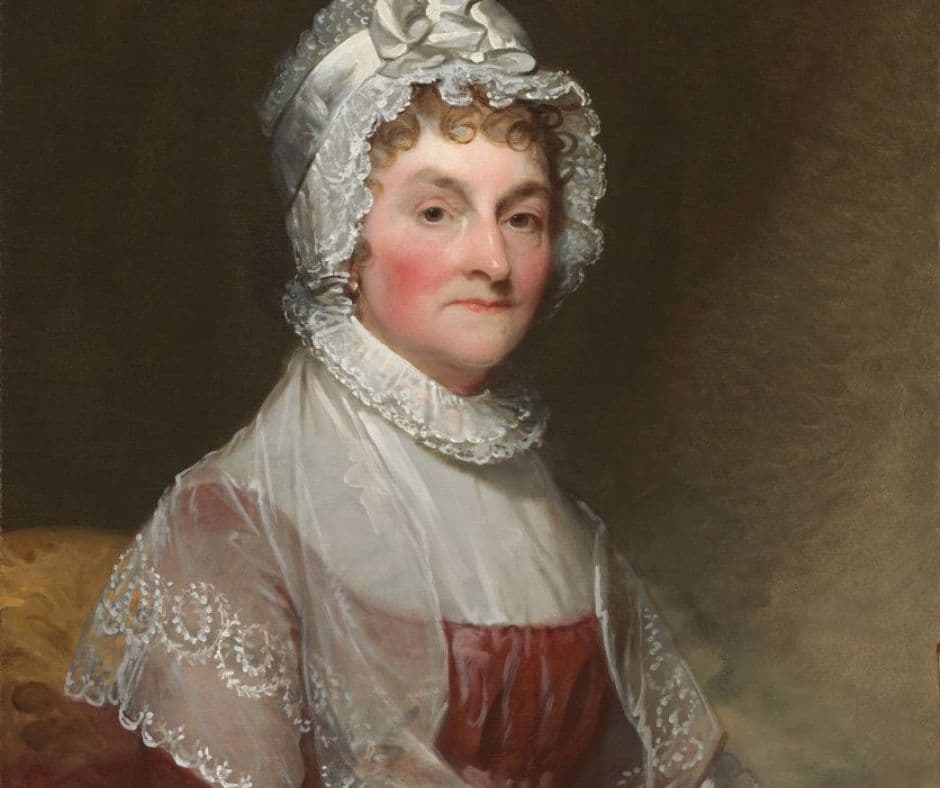
Abigail (Smith) Adams was born in 1744 and grew up in a small village about 12 miles from Boston, Massachusetts. Her family was well-established and politically involved. Abigail was a voracious reader and was equally outspoken when it came to politics.
In the 18th century, women did not have many rights. They could not vote, and many did not know how to read or write. To speak about politics was frowned upon. Females were expected to marry well, raise their children, and take care of the home.
Abigail Adams, however, did not appreciate the rules set forth by society, and she frequently said or wrote what was on her mind. In one letter to her husband, John Adams, she said, “my pen is always freer than my tongue.”
Abigail Adams and Women’s Rights
Abigail Adams met John Adams when she was 17 years old. Her parents insisted they have a long engagement, so they waited until October 24, 1764, when she was 19 and John was 28, to get married. This was a rough time in America, known then as “the colonies.” The colonies were under British rule and there was a lot of discontent among the colonists. In 1774, John went to Philadelphia for the First Continental Congress, a meeting between representatives of the 13 colonies. Tensions were rising between the colonists and the British government. It was during this time that Abigail and her husband started exchanging letters, giving us an insight into her political beliefs and the way she championed for women’s rights.
On April 19, 1775, the Revolutionary War began as the colonists wanted to separate themselves from British rule. As the people fought for independence, Abigail Adams wrote to her husband, saying that independence should be applied to women as well as men. In 1778, she wrote, “you need not be told how much female education is neglected, nor how fashionable it has been to ridicule female learning.” In another letter, she said, “I desire you would Remember the ladies, and be more generous and favourable to them than your ancestors. Do not put such unlimited power into the hands of Husbands.”
In 1775, Abigail Adams was asked to join an all-female jury to question Massachusetts women who were thought to be Loyalist supporters. This was her first public responsibility and not one she liked or even wanted. “I expect to be vilified and abused,” she confessed.
In 1796, John Adams became the second president of the United States, making Abigail the second first lady. She was also the first first lady to live in the White House. Initially, she remained politically vocal, but being in the public eye and under such scrutiny weighed on her. The first lady found herself having to rein back on her responses. She wrote, “I have been so used to freedom of sentiment that I know not how to place so many guards about me, as will be indispensable, to look at every word before I utter it, and to impose a silence upon myself, when I long to talk.”
Abigail Adams supported most of her husband’s political views and often advised him in such matters. Abigail and John were good friends with Thomas Jefferson, the author of the Declaration of Independence. She wrote frequently to Jefferson, until the presidential election of 1800, when he decided to run against her husband.
The election campaign was a bitterly contested one and the Jeffersonian press said that Abigail Adams was too outspoken and imperious. One of the opponents, Albert Gallatin, wrote, “She is Mrs. President, not of the United States but of a faction…It is not right.”
Abigail was not too disappointed when John lost the presidential election to Jefferson in 1800. By that time, she said she was, “sick, sick, sick, of public life.” From the beginning, she’d expected to suffer discontent with her political position, saying she’d felt “fastened up hand and foot and tongue to be shot at.”
Abigail and John returned home to retire. One of their children, John Quincy Adams, would later become the sixth president of the United States, although Abigail did not live to see that day. She died on October 28, 1818, at the age of 73 from Typhoid Fever.
To this date, Abigail Adams is one of two first ladies to have a son become president; Barbara Bush was the mother of George W. Bush, the 43rd president.
Test Your Knowledge – Take the Quiz
Try a quiz based on this article
Abigail Smith was born in 1744 and was raised just outside of:
Show the answer
Boston, MA.
Abigail married________ in 1764 when she was 19 years old.
Show the answer
John Adams.
Who ruled the 13 colonies before America gained its independence?
Show the answer
Britain.
Abigail was a major advocate for:
Show the answer
Women’s rights.
What war began on April 19, 1775?
Show the answer
Revolutionary War.
Abigail was the first woman to:
Show the answer
Live in the White House.
Abigail and her husband were good friends with ___________, the author of the Declaration of Independence.
Show the answer
Thomas Jefferson.
During her husband’s election campaign, Abigail was accused of being outspoken and imperious.
Show the answer
True.
One of John and Abigail's sons, John Quincy Adams, became the ______ president of the United States.
Show the answer
6th.